.png)
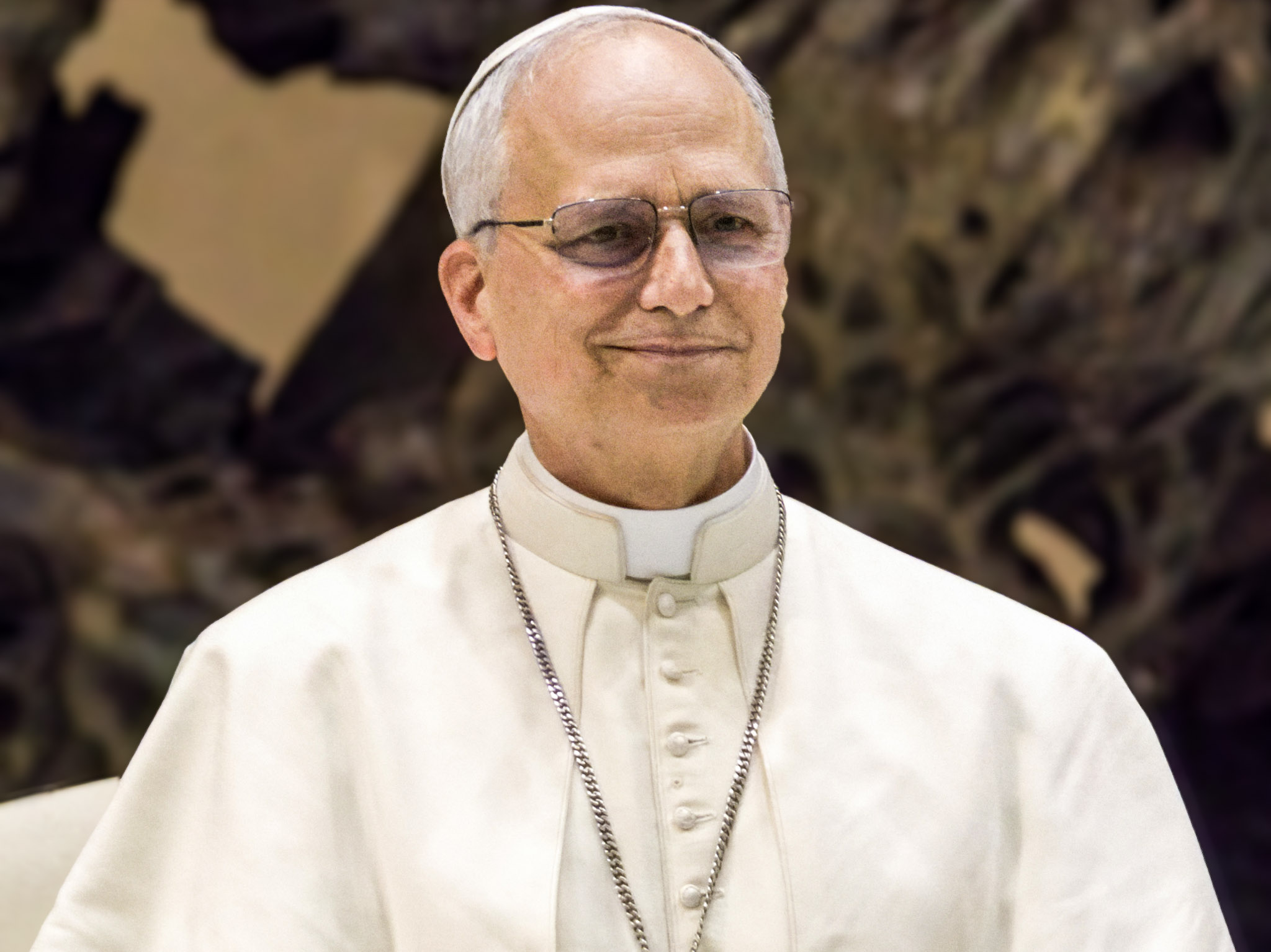
WASHINGTON — An extraordinary public feud between President Donald Trump and Pope Leo XIV over the last few days has driven speculation about whether the Chicago-born pontiff could run for president himself.
“I’d vote for Pope president,” read one X post that drew more than 40,000 likes. “Or does being the Pope trigger some law preventing that.”
Leo, elected pope last May by the College of Cardinals, is the first American in a line of 267 popes. But could he actually run for president, legally?
The short answer: Definitely not under canon law, but maybe under the U.S. Constitution.
Not that he would.
“The Holy Father is not a politician, nor should he be reduced to one,” Bishop John Dolan of Phoenix said in a statement provided by the diocese.
The spat between the two most recognizable American leaders in the world began when Leo expressed anti-war sentiments at a Palm Sunday Mass on March 29.
“Jesus is the King of Peace, who rejects war, whom no one can use to justify war,” Leo told the faithful in St. Peter’s Square. “He does not listen to the prayers of those who wage war, but rejects them.”
Trump bristled at the implicit criticism of the U.S. war with Iran.
Days later, news surfaced that Leo, the spiritual leader of 1.4 billion Catholics worldwide, had met recently with David Axelrod, a campaign strategist for former President Barack Obama and a high-profile critic of Trump.
The internet erupted. Anti-Trumpers trolled the president, suggesting he might have a political rival.
Here’s what the speculation around a hypothetical presidential run comes down to:
Since 1917, canon law barred clergy members from public office, though it allowed exceptions with the permission of a bishop. In 1983, Pope John Paul II closed the exception loophole.
Catholic clergy are expected to be “a man who is dedicated to God” and to restrict themselves to “appropriate work for Catholic clerics,” according to Canon Law Made Easy, a website maintained by Cathy Caridi, an American canon lawyer.
But popes themselves are the supreme authority on canon law. In theory, Leo could loosen or end the restriction.

The U.S. Constitution spells out three qualifications to be president.
To run and serve, a person must be born a U.S. citizen, at least 35 years old by inauguration day, and a 14-year resident of the United States.
Leo turned 70 in September and was born in Chicago, so he clears the first two hurdles easily.
As for the third rule, Leo spent much of his life outside the U.S. His last U.S.-based assignment from the church ended in 2014.
But legal scholars generally agree that the Constitution doesn’t require 14 years of continuous residence.
“The 14 years of residence need not immediately antedate candidacy for the presidency and may be cumulative not consecutive,” Bruce Fein, a constitutional lawyer who was a top Department of Justice official in the Reagan administration, said by email. “The purpose is to guarantee a minimal attachment and knowledge and experience with conditions in the United States.”
At least three presidents – Herbert Hoover, James Buchanan and William Howard Taft – had lived abroad for some of the 14 years preceding their elections.
According to a Virginia Law Review article from 1929, the Framers of the Constitution debated the point in 1787 and agreed that the 14-year test referred to residence “in the whole” – in total but not necessarily continuous or most recent.
There are two other wrinkles, though.
Leo became a naturalized citizen of Peru in 2015, though he retained his U.S. citizenship. He was serving in Peru in 2015 when Pope Francis appointed him Bishop of Chiclayo, and when Francis elevated him to archbishop in January 2023 and cardinal in September 2023.
Now, as the Bishop of Rome, Leo is also a head of state as ruler of Vatican City.
Under the Immigration and Nationality Act, holding public office in a foreign country can trigger expatriation – loss of citizenship. The State Department says such cases will be reviewed proactively only when “a U.S. national is elected or otherwise appointed to serve as a foreign head of state, foreign head of government, or foreign minister.”
Leo would bring some assets to a hypothetical run for president.
Roughly 20% of Americans identify as Catholic. The ratio is about the same in Arizona. And he is popular even beyond that natural base of support.
He has not been entirely removed from worldly politics.
He voted in his home state, Illinois, in five of the last seven presidential elections, most recently in 2024, according to records obtained by CBS News.
Leo also voted in Illinois Republican primaries in 2012, 2014 and 2016, and the state’s Democratic primaries in 2008 and 2010. Trump also voted in the 2008 Democratic primary, in New York.
Trump doesn’t have to worry about ever facing Leo on a ballot, though – not because of restrictions against the pope but because the Constitution bars presidents from seeking a third term.
Still, the pope’s megaphone is at least as loud as Trump’s, which helps explain why the president hit back so hard after he warned Saturday evening against “delusion of omnipotence.”
“Enough of the display of power! Enough of war!” Leo told worshippers in St. Peter’s Basilica.
In a Truth Social post Sunday night, Trump called the pope “WEAK on Crime, and terrible for Foreign Policy” and urged him to “focus on being a Great Pope, not a Politician.”
He also took credit for Leo’s elevation to the papacy, asserting that the cardinal electors “thought that would be the best way to deal with President Donald J. Trump. … If I wasn’t in the White House, Leo wouldn’t be in the Vatican.”
Trump continued the attacks that night before boarding Air Force One in Florida.
“I’m not a big fan of Pope Leo. He’s a very liberal person, and he’s a man that doesn’t believe in stopping crime,” he told reporters.
On Monday, the pope responded by telling his own traveling press corps that he is “not afraid of the Trump administration.”
“The things that I say are certainly not meant as attacks on anyone,” Leo said during a flight to Algiers. “I do not view my role as being political. … I don’t want to get into a debate with him.”But he said, “I will continue to speak out loudly against war.”
For more stories from Cronkite News, visit cronkitenews.azpbs.org.
This article first appeared on Cronkite News and is republished here under a Creative Commons Attribution-NoDerivatives 4.0 International License.
Source New Mexico: Uranium mine under consideration near sacred Mount Taylor
Native America Calling: Exploring home, culture, and personal resolve with writers Joan Kane and Sherman Funmaker
Montana Free Press: Lawsuit challenges cancellation of federal grants for tribal agricultural programs
Press Release: Institute of American Indian Arts announces scholarship created by Pueblo artist Rose B. Simpson
Press Release: Umatilla Tribes approve contract for Native legal aid program
Press Release: Department of Transportation opens $19 million tribal grant program
Native America Calling: Oil drilling vs cultural preservation at Chaco Canyon
NAFOA: 5 Things You Need to Know This Week (May 26, 2026)
Native America Calling: Border wall construction damaging sacred sites
Chuck Hoskin: Cherokee Nation promotes compassion and responsibility
Native America Calling: Wide disparities persist when encountering ancestors’ remains (Encore Presentation)
Press Release: Sen. Murkowski (R-Alaska) discusses tribal priorities at oversight hearing
Native America Calling: A conversation with Native wellness advocates Chelsea Luger and Thosh Collins
Cronkite News: Former MAGA figure denounces Trump’s ‘slush fund’ for criminal defendants
More Headlines