Indianz.Com > News > ‘These are treaty and trust responsibilities’: Lawmakers struggle with tribal water rights
Senate Committee on Indian Affairs: Oversight Hearing on “Examining Federal Policies Governing Indian Water Rights Settlements,” and Legislative Hearing to receive testimony on S.953, Northeastern Arizona Indian Water Rights Settlement Act of 2025
‘These are treaty and trust responsibilities’: Lawmakers struggle with tribal water rights
Thursday, March 12, 2026
Indianz.Com

WASHINGTON, D.C. — President Donald Trump isn’t known for being shy on any issue but when it comes to a basic necessity in Indian Country, his administration isn’t quite as forthcoming.

For the first time in the 119th Congress, the Trump administration got a chance to explain its stance on Indian water rights settlements. At a hearing on Wednesday, a political official from the Department of the Interior (DOI) confirmed that a long-running policy at the federal agency with the most trust and treaty responsibilities remains in place despite a change in power in the nation’s capital.

“The department supports the long-standing policy that negotiated Indian water rights settlements are … certainly preferable to protracted and divisive litigation,” Deputy Assistant Secretary for Water and Science Scott Cameron told the Senate Committee on Indian Affairs.

“Settlements can resolve long-standing claims, provide certainty to water users, promote tribal sovereignty and self-sufficiency and support to the development of water infrastructure that improves conditions on and off reservations,” Cameron added.

But when it comes to actually bringing water to tribal communities, Cameron wasn’t quite able to commit. He said DOI can’t support S.953, the Northeastern Arizona Indian Water Rights Settlement Act of 2025, due to its high price tag of $5.1 billion.

“While the department certainly supports the goals of S.953, we do have real concerns with the overall cost of the settlement,” Cameron said of a bipartisan bill that will finally ratify the water rights of the Hopi Tribe, the Navajo Nation and the San Juan Southern Paiute Tribe in the Colorado River basin of northeastern Arizona.

But concerns about cost even extend to a tribal settlement that has already been approved by the U.S. Congress. Although Cameron has been given authority over the Bureau of Reclamation, he refused to say whether the Trump administration will ask for money to keep working on the Navajo-Gallup Water Supply Project, a major infrastructure initiative that benefits communities on and off the Navajo Nation in New Mexico.

“I can’t speak to the president’s 2027 budget,” said Cameron, who nevertheless told Sen. Ben Ray Luján (D-New Mexico) that the water pipeline is a “number one priority” at DOI.

“We are doing everything we can to deliver on, you know, on time on that project,” Cameron testified. “It’s the biggest construction project in the Bureau of Reclamation.”

Sen. Steve Daines (R-Montana): Complete the Fort Belknap Water Settlement, Support Montana’s Hi-Line

Cameron even refused to bend the rules for a friendly Republican who has been an eager supporter of President Trump. He wouldn’t tell Sen. Steve Daines (R-Montana) whether DOI supports — or doesn’t support — the Northern Montana Water Security Act, despite every sponsor and co-sponsor of S.241 being from the GOP.

“The administration hasn’t taken a formal position on that bill yet,” Cameron said of Republican-led legislation to ratify the water rights of the Fort Belknap Indian Community, whose citizens have been waiting decades for a settlement.

Instead, Cameron indicated that it would take yet another hearing for DOI to come up with a stance on the last remaining tribal water rights deal in Montana.

“We haven’t an opportunity to testify, but certainly can commit to you, to working on the legislation and finding a path forward,” Cameron told Daines, who made a surprise announcement last week and said he wouldn’t seek re-election this year.

Steve Daines
Sen. Steve Daines (R-Montana) speaks in support of the Northern Montana Water Security Act at a Senate Committee on Indian Affairs hearing in Washington, D.C., on March 11, 2026. Photo by Indianz.Com (CC BY-NC-SA 4.0)

Similarly, Cameron demurred when asked by Sen. Lisa Murkowski (R-Alaska), the Republican chair of the Senate Committee on Indian Affairs, about tribal settlements that have already been through multiple sessions of Congress. He said DOI might be able to show its cards if further hearings were to be scheduled in the U.S. House of Representatives.

“Senator, we typically don’t take position on legislation until we’re invited to testify in those particular bills,” Cameron said. “So I guess our next opportunity might be over on the House side, you know, to express it a formal administration position.”

But time is running out for Indian Country. Lawmakers have until the end of 2026 to complete work on a slew of tribal water rights bills — that is, when they aren’t out campaigning as Republicans try to retain control of the House and the Senate when voters go to the polls in November.

“So the question before us is clear,” Murkowski said at the start of the hearing. “How do we continue to meet our solemn trust and treaty responsibilities while maintaining fiscal responsibility and balancing the many, many priorities that are facing Indian Country?”

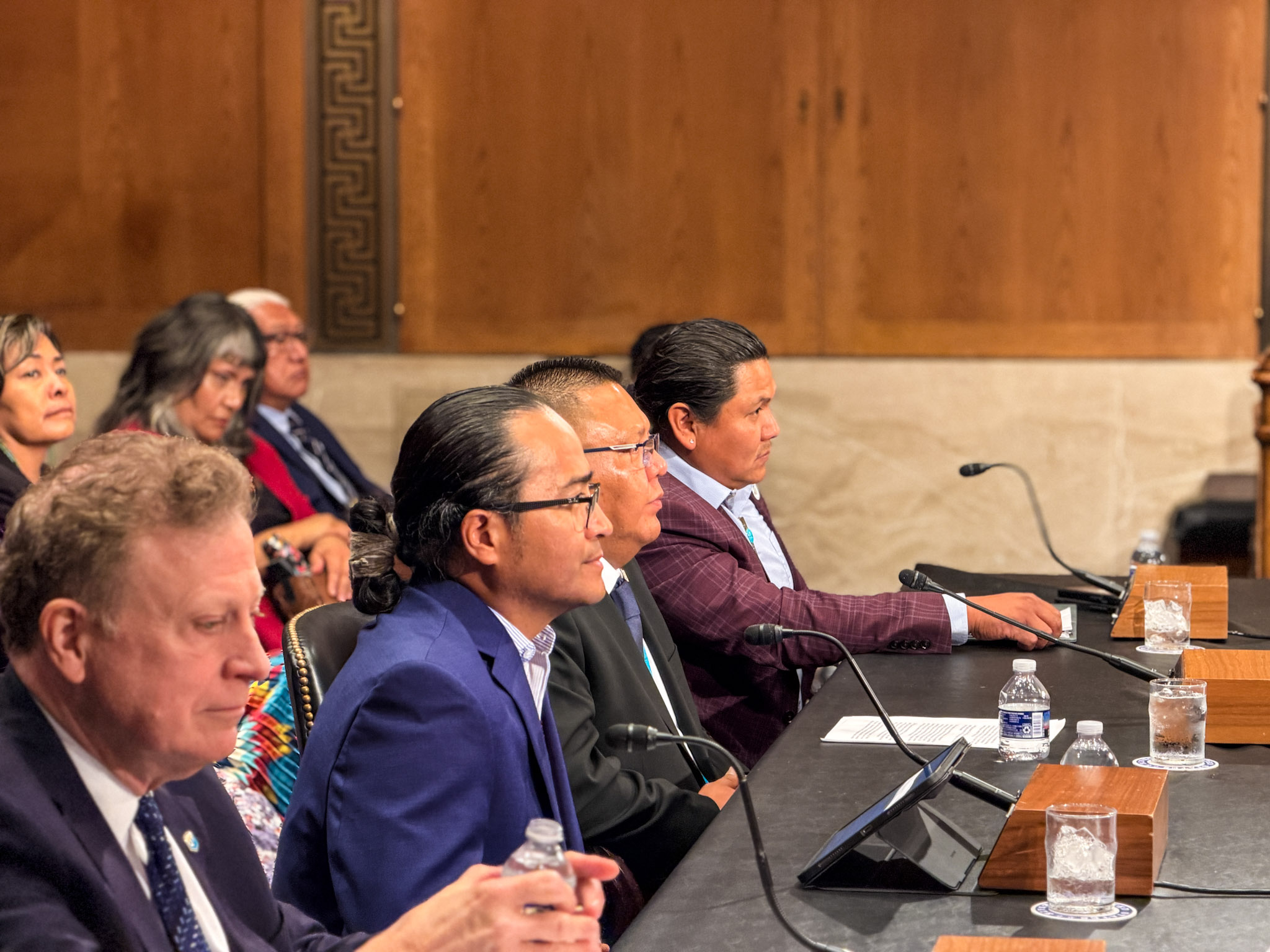
Scott Cameron, Buu Nygren, Lamar Keevama and Johnny Lehi Jr.
From left: Principal Deputy Assistant Secretary Scott Cameron of the Department of the Interior, President Buu Nygren of the Navajo Nation, Chairman Lamar Keevama of the Hopi Tribe and Vice President Johnny Lehi Jr. of the San Juan Southern Paiute Tribe testify about S.953, Northeastern Arizona Indian Water Rights Settlement Act before the Senate Committee on Indian Affairs in Washington, D.C., on March 11, 2026. Photo by Indianz.Com (CC BY-NC-SA 4.0)

According to Sen. Brian Schatz (D-Hawaii), the Democratic vice chair of the committee, 14 tribes are waiting on the United States to meet its legal obligations and deliver water to their communities. He put the cost of these legislative settlements at $12 billion and said that 13 more tribes are in active negotiations with DOI.

“Inaction is not an option,” said Schatz.

“The tribes have held up their end of the bargain,” Schatz said in reference to the millions of acres of land ceded in treaties and other government-to-government agreements between tribal nations and the U.S. “It is long past time for Congress to hold up ours.”

Both Murkowski and Schatz tried to get answers out of Cameron regarding the Indian Water Rights Settlement Completion Fund. The $2.5 billion fund was created by Congress in 2021 through the Bipartisan Infrastructure Law to ensure DOI has money to carry out approved tribal settlements.

Indianz.Com Audio: Oversight Hearing on “Examining Federal Policies Governing Indian Water Rights Settlements,” and Legislative Hearing to receive testimony on S. 953, Northeastern Arizona Indian Water Rights Settlement Act of 2025

Murkowski put the figure of pending tribal water settlement bills at $9 billion and Cameron agreed with the obvious — there currently isn’t enough money to fulfill the U.S. government’s promises for water in Indian Country.

“There’s very definitely a funding gap and a significant funding gap,” Cameron said.

And while Cameron repeatedly said he couldn’t disclose what President Trump plans to request in the fiscal year 2027 budget, he made it clear that tribal water isn’t in fact the “number one priority” at the Bureau of Reclamation.

“So, you know, we’d have to zero out virtually everything else going on in inside the bureau in order to fund, even $2 billion a year of Indian water rights settlements,” Cameron told the committee.

“I agree with Senator Schatz here,” Murkowski said in response. “We’ve got an obligation. These are treaty and trust responsibilities.”

Indianz.Com Video: Senate Committee on Indian Affairs – Business Meeting to consider several bills – March 5, 2025

At the committee’s first meeting of the 119th Congress a year ago this month, a slew of tribal water rights settlement bills were approved:

S.241, the Northern Montana Water Security Act of 2025. The bill settles the water rights of the Fort Belknap Indian Community in Montana.

S.562, the Rio San José and Rio Jemez Water Settlements Act of 2025. The bill settles the water rights of the Pueblos of Acoma, Laguna, Jemez and Zia to certain stream systems in New Mexico.

S.563, the Ohkay Owingeh Rio Chama Water Rights Settlement Act of 2025.The bill settles the water rights of Ohkay Owingeh to the Rio Chama in New Mexico.

S.564, the Zuni Indian Tribe Water Rights Settlement Act of 2025. The bill settles the water rights of the Pueblo of Zuni in New Mexico.

S.565, the Navajo Nation Rio San José Stream System Water Rights Settlement Act of 2025. The bill settles the water rights of the Navajo Nation to certain streams in New Mexico.

S.689, the Tule River Tribe Reserved Water Rights Settlement Act of 2025. The bill settles the water rights of the Tule River Tribe in California.

Lisa Murkowski
Sen. Lisa Murkowski (R-Alaska) presides over a Senate Committee on Indian Affairs hearing on tribal water rights in Washington, D.C., on March 11, 2026. Photo by Indianz.Com (CC BY-NC-SA 4.0)

Despite approval by the committee on a bipartisan basis, the tribal water bills have not yet seen further action in the Senate. In response to concerns raised by Sen. Alex Padilla (D-California), who is the sponsor of the settlement for the Tule River Tribe, even Murkowski admitted she didn’t have a good explanation.

“We have kind of gotten to a really difficult and frustrating — frustrating, as much as anything — time in our process,” Murkowski said on the Senate floor on February 26.

All of the tribal water bills approved by Murkowski’s committee in March 2025 already had hearings in the House — albeit during the last session of Congress. As Cameron stated on Wednesday, it would take even more hearings for DOI to express a position on the measures.

The Northeastern Arizona Indian Water Rights Settlement Act was also considered during the last session of Congress. The current version was introduced on March 11, 2025 — a year to the date of Wednesday’s hearing.

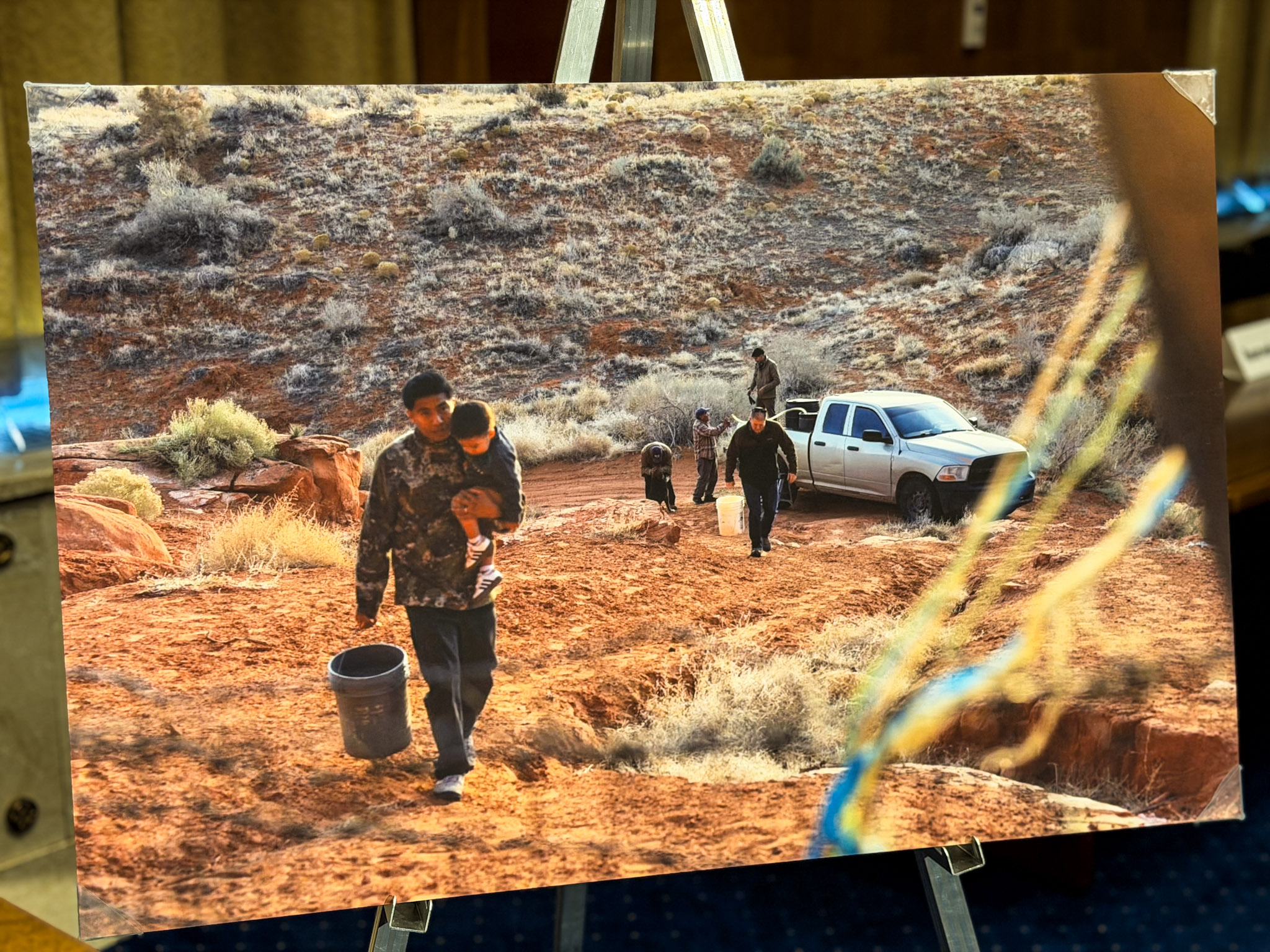
“Roughly, a third of Navajo households lack running water,” Navajo Nation President Buu Nygren testified “ I also grew up without running water.”

“Thousands of our people continue to haul water over 30 miles round trip to meet daily water demands,” Nygren added. “Hauling water is expensive. It also costs, on average, $600 per month for a family to haul water and countless hours for each trip. This is crippling for the many who live below the poverty line on the Navajo Nation.

“Congress must act to end the water crisis,” Nygren asserted.

Navajo Nation
A photo of water hauling on the Navajo Nation is displayed at a hearing of the Senate Committee on Indian Affairs in Washington, D.C., on March 11, 2026. Photo by Indianz.Com (CC BY-NC-SA 4.0)

Similar conditions exist for citizens of the neighboring Hopi Tribe, Chairman Lamar Keevama told the committee. “Water infrastructure is either aging or non-existent,” he said.

“Thirty percent of those living on the Hopi Reservation do not have running water and must haul water to their homes,” Keevama continued. “This legislation will fund critical infrastructure projects such as wells, pipelines, treatment systems and storage facilities that are necessary to deliver safe and reliable water to our communities.”

But for all the concerns about the $5.1 billion envisioned by the Northeastern Arizona Indian Water Rights Settlement Act, the bill represents something even more valuable to the San Juan Southern Paiute Tribe. Vice President Johnny Lehi Jr. said his people would finally have a permanent place to call home, a goal his grandmother had been pursuing for decades when she was in tribal leadership.

“Our elders, including my father, carried our tribe through the long work of survival and recognition,” Lehi said. “The parents and grandparents of my council members in these chambers spent their lives fighting for our people to have a homeland.”

“Many have passed on,” Lehi added. “That is why this moment matters so much to me, my council members and our elders.”

Senate Committee on Indian Affairs Testimony
PANEL 1
The Honorable Mark Kelly [Press Release: Kelly Introduces Tribal Leaders and Highlights Arizona Water Settlement at Senate Indian Affairs Hearing]
Senator from Arizona
Sponsor of S.953

PANEL 2
Mr. Scott Cameron [PDF: Written Testimony]
Principal Deputy Assistant Secretary – Water and Science
Exercising the Delegated Authority of Commissioner
Bureau of Reclamation
Department of the Interior
Washington, DC

The Honorable Buu Nygren [PDF: Written Testimony]
President
Navajo Nation
Window Rock, Arizona

The Honorable Lamar Keevama [PDF: Written Testimony]
Chairman
Hopi Tribe
Kykotsmovi Village, Arizona

The Honorable Johnny Lehi Jr. [PDF: Written Testimony]
Vice President
San Juan Southern Paiute Tribe
Tuba City, Arizona

Senate Committee on Indian Affairs Video
Opening Remarks

Sen. Mark Kelly (D-Arizona)

Scott Cameron / Department of the Interior

President Buu Nygren / Navajo Nation

Chairman Lamar Keevama / Hopi Tribe

Vice President Johnny Lehi Jr / San Juan Southern Paiute Tribe

Questions and Answers

Senate Committee on Indian Affairs Notice
Oversight Hearing on “Examining Federal Policies Governing Indian Water Rights Settlements,” and Legislative Hearing to receive testimony on S. 953, Northeastern Arizona Indian Water Rights Settlement Act of 2025 (March 11, 2026)

Related Stories
VIDEO: Examining Federal Policies Governing Indian Water Rights Settlements and S.953, Northeastern Arizona Indian Water Rights Settlement Act (March 11, 2026)
AUDIO: Examining Federal Policies Governing Indian Water Rights Settlements and S.953, Northeastern Arizona Indian Water Rights Settlement Act (March 11, 2026)
Testimony: Johnny Lehi Jr. of San Juan Southern Paiute Tribe (March 11, 2026)
Testimony: Lamar Keevama of Hopi Tribe (March 11, 2026)
Testimony: Buu Nygren of Navajo Nation (March 11, 2026)
Testimony: Scott Cameron of Department of the Interior (March 11, 2026)
Senate Committee on Indian Affairs sets hearing on water rights (March 10, 2026)
Arizona Mirror: Bipartisan bill provides $5.1 billion for tribal water settlement (March 19, 2025)
Search
Filed Under
Tags
More Headlines