Indianz.Com >
News > Native Republican tapped for Cabinet post in surprise shakeup
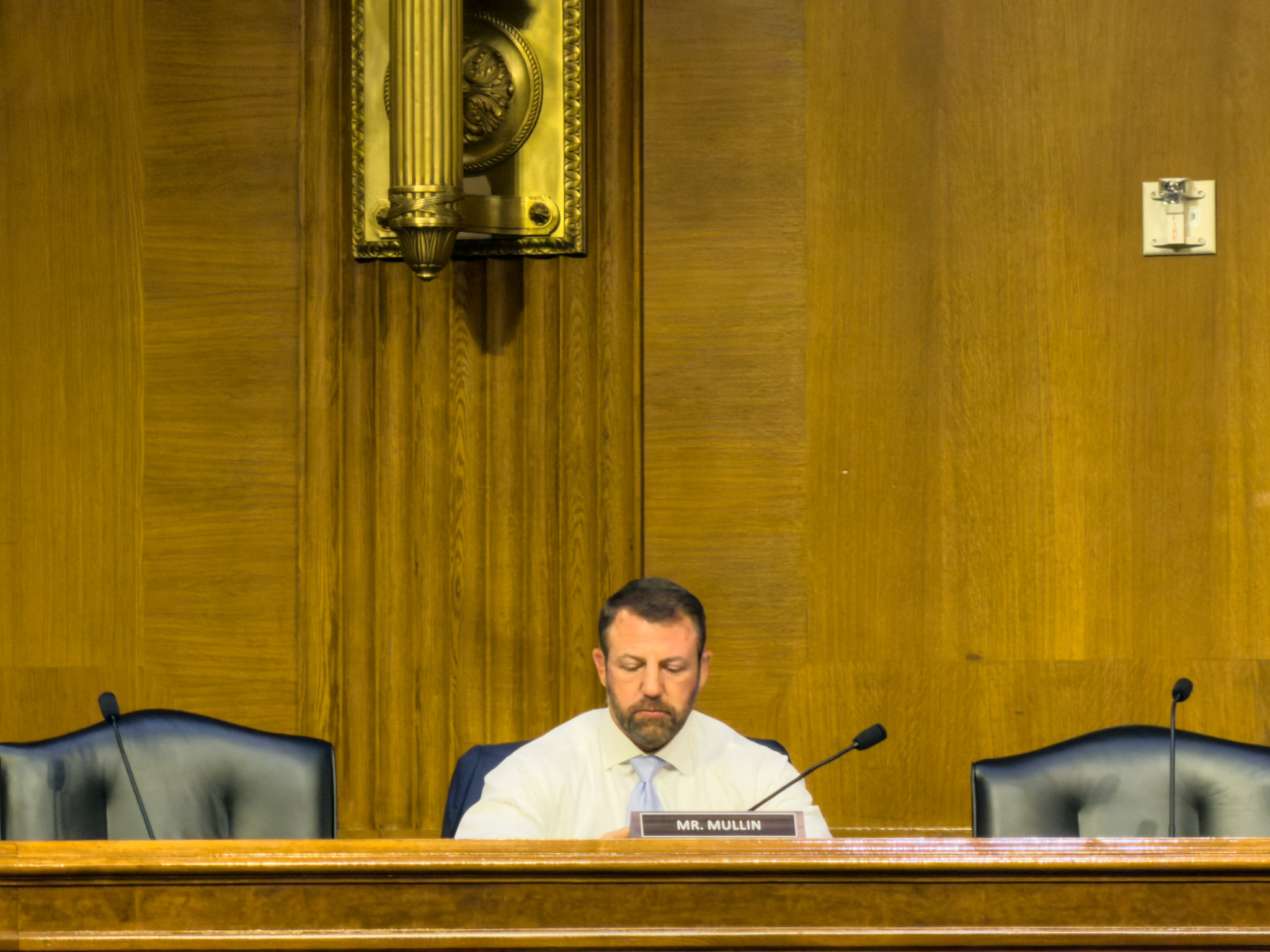 Sen. Markwayne Mullin (R-Oklahoma) sits behind the dais at a hearing of the Senate Committee on Indian Affairs in Washington, D.C., on November 5, 2025. Photo by Indianz.Com (CC BY-NC-SA 4.0)
Native Republican tapped for Cabinet post in surprise shakeup
Indianz.Com
By Acee Agoyo
Indianz.Com
Sen. Markwayne Mullin (R-Oklahoma) is poised to make history as the first Native person in the Donald Trump cabinet following a shakeup in the Republican president’s administration.
The
Department of Homeland Security has been led by Kristi Noem, a former governor of South Dakota who angered tribes in her home state with her anti-tribal sovereignty stances. She was removed by Trump on Thursday after
back-to-back appearances on Capitol Hill in which she
drew fire from Republicans and Democrats alike.
Mullin, a citizen of the Cherokee Nation, was
quickly announced by Trump as the new Secretary of Homeland Security. He appeared as surprised as the general public when he
found out the news.
“President Trump ran on restoring law and order, and he quickly delivered the most secure U.S. border in American history. I look forward to supporting POTUS’ mission to safeguard the American people and defend the homeland,”
Mullin said in a statement on Thursday afternoon.
Mullin, a member of the
Senate Committee on Indian Affairs, is the only tribal citizen serving in the
U.S. Senate. He won election in November 2022 after
boasting of being the “only true Native American” in the chamber, a subtle dig at
Sen. Elizabeth Warren (D-Massachusetts) who had
falsely claimed Native heritage from Oklahoma.

youtu.be
Indianz.Com Video: The only true Native American in the Senate’: Markwayne Mullin at National Tribal Health Conference #NTHC2022
Previously, Mullin served five terms in the
U.S. House of Representatives after breaking a promise to limit himself to three terms. He was a member of the
House Committee on Natural Resources, the legislative panel with jurisdiction over Indian issues in the chamber.
Mullin’s legislative work now takes him into an entirely new arena. He’s never held an executive-level office and he lacks a background in law enforcement, border security and immigration, some of the key areas at the Department of Homeland Security (DHS), which has faced significant criticism for a
nationwide crackdown that has ensnared Native people.
But Trump’s surprise shift in Washington, D.C., is drawing praise in Indian Country despite Mullin’s limited dealings — so far — in matters of homeland protection.
“The Cherokee Nation extends its warmest congratulations to Cherokee Nation citizen and Westville native Markwayne Mullin on this historic appointment as the United States Secretary of Homeland Security,”
Principal Chief Chuck Hoskin Jr. said in a statement.
“Senator Mullin’s dedicated service in the U.S. Senate has demonstrated his unwavering commitment to progress and the well-being of all communities, including Indian Country,” continued Hoskin. “It is deeply encouraging to have someone with a keen understanding of federal Indian policy, law and justice elevated to such a critical leadership role within a powerful federal agency.”
Just last month, the
National Congress of American Indians criticized the Trump administration for the immigration crackdown, in which a number of Native people were detained despite being United States citizens. But the largest inter-tribal advocacy organization is welcoming Mullin’s new role in the executive branch.
“As the nomination process moves forward, NCAI looks forward to hearing more about Senator Mullin’s priorities for DHS and how he plans to work with Tribal Nations,” a
statement from the organization read. “Robust, timely Tribal consultation and sustained collaboration with Tribal governments will be essential as DHS addresses issues such as border security, emergency management, cybersecurity, and infrastructure protection that affect Tribal lands and citizens.”
“NCAI remains committed to working with leaders across the federal government and with Congress to ensure that Tribal sovereignty is respected and that the priorities of Tribal Nations are reflected in national policy discussions,” the statement continued.
And
Rep. Tom Cole (R-Oklahoma), one of only three tribal citizens in the House, praised Mullin’s historic selection as the first Native person to lead DHS, the most recently created cabinet-level federal agency.
“Service to the country is one of the highest callings in public life,”
said Cole, a citizen of the Chickasaw Nation. “I am proud to see my congressional colleague, friend, and fellow Native American, Senator Markwayne Mullin, receive this well-deserved nomination to serve as President Trump’s Secretary of Homeland Security.”
“As a member of the Senate Appropriations Committee, he has been a strong partner and a steady leader working across chambers. Markwayne understands the critical importance of securing the homeland and protecting our communities, and I am confident he will serve with distinction in this new role,” Cole added. “Vigilance and strength are essential to protecting the nation, and Oklahomans — and the American people — can be confident he will carry out that mission with the resolve it demands.”
Even Trump himself highlighted Mullin’s unique background as he shifted
Noem into a previously unheard of position in his administration.
“As the only Native American in the Senate, Markwayne is a fantastic advocate for our incredible Tribal Communities,”
Trump said in a social media post on early Thursday afternoon.
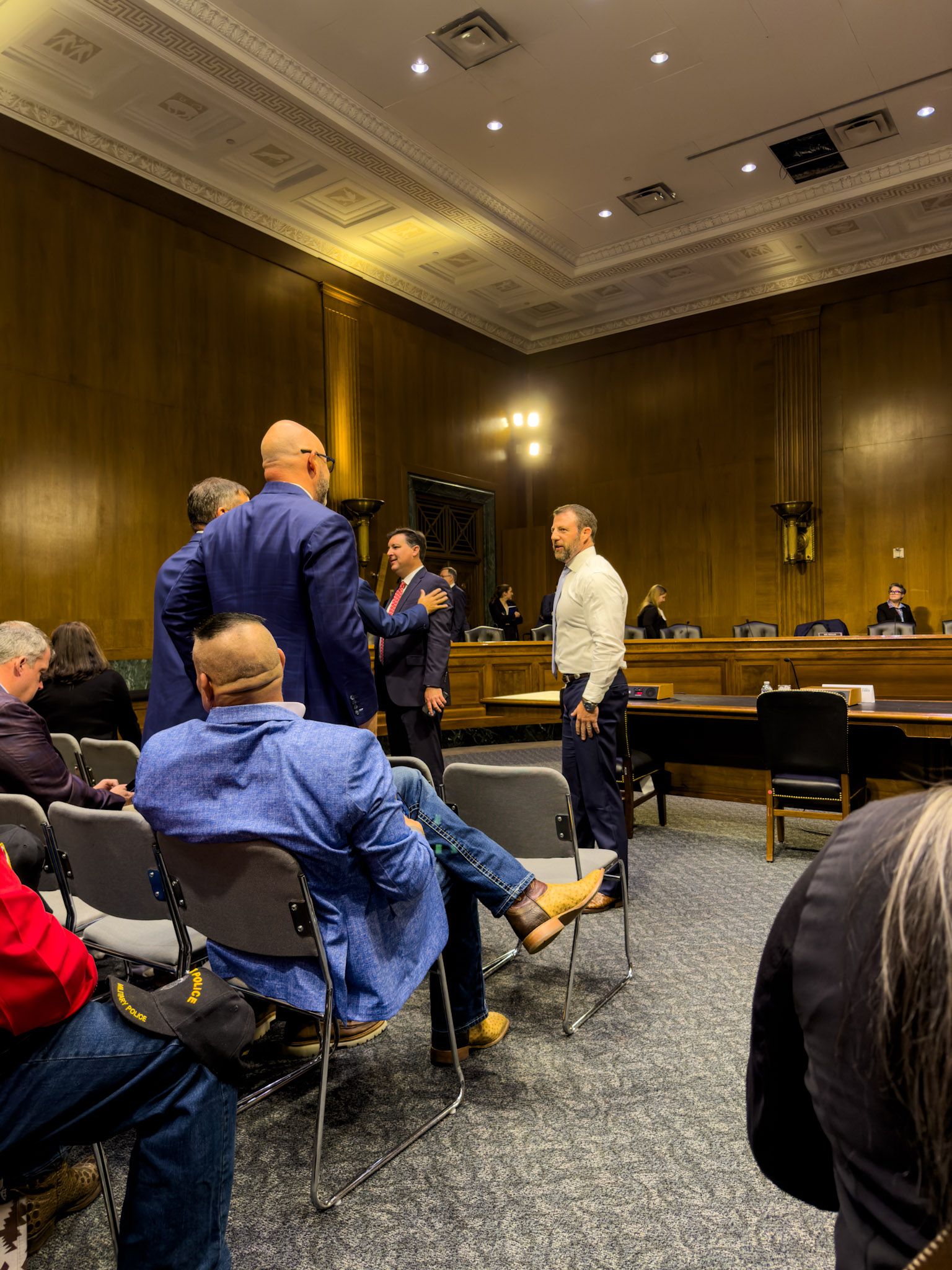
Sen. Markwayne Mullin (R-Oklahoma), right in white shirt, engages with representatives of the Lumbee Tribe prior to the start of a hearing of the Senate Committee on Indian Affairs in Washington, D.C., on November 5, 2025. Photo by Indianz.Com (CC BY-NC-SA 4.0)
Mullin is known as an eager defender of Trump and Trump’s policies, regardless of the subject area. Among them was his strong support of federal recognition for the
Lumbee Tribe in North Carolina despite questions about the legitimacy of the so-called People of the Dark Water.
During a
Senate Committee on Indian Affairs hearing last November, Mullin raised eyebrows when he suggested that the outward appearance of a group of people justified their
acknowledgment as a tribal nation and a government-to-government relationship with the United States.
“Because you can’t look over there and say they’re not Native. I mean, turn around and look and you’re telling me they’re not Native?” Mullin told Principal Chief Michell Hicks of the
Eastern Band of Cherokee Indians, which opposed legislative recognition for the Lumbees.
“I’ve seen the crowd. Okay. Okay,” Mullin said. “And you’re saying that they, that’s not Native faces?”
Mullin’s hostile treatment of a fellow Cherokee — and a Cherokee leader at that — came after he ignored Chief Hicks and other Native advocates prior to the start of the hearing. He eagerly greeted and laughed with the Lumbee contingent that was seated on the left side of the Senate hearing room but failed to take a few more steps to acknowledge tribal people from his home state.
Mullin, who
famously walked in late to his first-ever meeting of the committee, instead chose to take a seat behind the dais, where he sat alone before the proceeding started. The visible snub that didn’t go unnoticed among those present.
“He spent more time in North Carolina last year than he did in Oklahoma,” one of the tribal advocates told Indianz.Com after the hearing.
Mullin’s next step would be a nomination hearing before the
Senate Committee on Homeland Security. The panel is chaired by
Sen. Rand Paul (R-Kentucky), whom
Mullin reportedly described as a “snake” for not going along with President Trump on every single issue.
Historically, the Senate has given wide latitude to members and former members who are nominated for political posts in the executive branch. Senators are often chosen for such positions because confirmation is considered a sure win.
Trump’s current cabinet, however, has drawn more members from the House.
The Department of Homeland Security includes Immigration and Customs Enforcement, otherwise known as ICE. When citizens of the Oglala Sioux Tribe were arrested and detained by ICE during a major crackdown in Minnesota, then-Secretary Noem refused to share information unless a restrictive agreement was signed, according to
President Frank Star Comes Out, who refused to sign anything that did not fully respect tribal sovereignty.
“Countless Native folks have been stopped and questioned, and even detained by immigration enforcement agents,”
Sen. Tina Smith (D-Minnesota) said in the Congressional response to
NCAI’s State of Indian Nations last month.
“It is cruelly ironic that Native people, the Indigenous people of this land, are being accused of illegally immigrating,”
said Smith, who has served on the Senate Committee on Indian Affairs alongside Mullin.
NCAI President Mark Macarro also called out the Trump administration for the enforcement efforts, which led to the
killing of Renee Nicole Good, a non-Native woman, by an ICE agent in Minnesota. Tribes in the state condemned the violent presence of DHS on their homelands.
“And make no mistake, we stand in unity with all of our relatives in Minnesota,”
Macarro said in the State of Indian Nations on February 9.
Noem’s aggressive tactics — which she said were requested by Trump — extended even to college campuses. Native youth leaders said
“Immigration enforcement actions on college campuses have created fear and uncertainty among students across the United States,”
NCAI Youth Commission Co-President Jonas Kanuhsa, a citizen of the Turtle Mountain Band of Chippewa Indians, said last month.
“Indigenous peoples have lived on these lands since time immemorial, and yet many Native students have faced questioning, harassment and even detention simply because of how they look,” Kanuhsa added.
“No student should have to carry their tribal enrollment card and passport out of fear,”
Kanuhsa asserted during the State of Indian Nations.
As a result of widespread outrage over Trump’s immigration agenda, Congress has been unable to approve an appropriations bill that funds DHS. The agency has been in a partial shutdown since February 14, with lawmakers insisting on reforms — including those affecting Indian Country.
“Department personnel interact with tribes and thousands of tribal members every day,” language accompanying a DHS appropriations bill [
H.R.7744] reads. “Some Department personnel do not have training on tribal issues, which may lead to misunderstandings that negatively impact tribes, tribal members, and ultimately, the Department.”
“The Department is required under Executive Order 13175 to consult and coordinate with tribal governments,” the explanatory statement continues. “The Department shall continue to consult and work with tribes to improve the mandatory, base-level training
course for Department personnel, including but not limited to FTE, part-time employees, and contractors, who have regular inter-actions with tribal members or are likely to
encounter tribal members at their duty station.”
“This training should include education on recognizing tribal identification documents as valid forms of identification,” the text concludes. “Within 180 days of the date of enactment of this Act, the Department is directed to brief the Committees on the status of such training improvements.”
Mullin serves on the
Senate Committee on Appropriations, where he chairs the
Legislative Branch Subcommittee.