Indianz.Com >
News > Supreme Court rejects Indian law cases amid U.S. government shutdown
 The U.S. Supreme Court is seen on October 6, 2025, five days after the federal government entered into a shutdown due to a lapse in appropriations. Photo by Indianz.Com (CC BY-NC-SA 4.0)
Supreme Court rejects Indian law cases amid U.S. government shutdown
Monday, October 6, 2025
By Acee Agoyo
Indianz.Com
As the shutdown of the federal government enters its first full week, the nation’s highest court remains open for business.
But the
U.S. Supreme Court does not seem interested in addressing any issues of interest in Indian Country. In a
lengthy order list released on Monday, the first day of the
court’s new October 2025 term, the justices denied petitions in three pending cases, affecting everything from tribal sovereignty to sacred sites.
“So remember the court hears probably anywhere from 50 to 70 cases per term, and it is asked to hear like 5,000 to 7,000,” Melody McCoy, a staff attorney with the
Native American Rights Fund, told tribal leaders earlier this year.
“So it picks like 1 percent,” said McCoy, a citizen of the
Cherokee Nation whose work includes the
Tribal Supreme Court Project. “It’s all the court’s discretion.”
Indianz.Com Audiof: Melody McCoy of Native American Rights Fund at National Congress of American Indians #ECWS2025
As
McCoy noted at the executive council winter session of the
National Congress of American Indians (NCAI), tribes initiated the project to improve their track record at the Supreme Court. In the term before the September 2001 launch, tribal interests lost four of out five cases that were heard by the justices.
“Its purpose is to strengthen tribal advocacy before the United States Supreme Court and improve the win-loss record of tribal interests by developing new litigation strategies and coordinating legal resources,” McCoy said of the project at NCAI’s meeting in Washington, D.C., in February.
Despite the focus of NARF and NCAI, along with hundreds of attorneys and academics across the nation, the effort has proved challenging. Between 2006 and 2016, tribal interests lost nine out of 11 cases heard by the justices.
More recently, however, the Supreme Court has been avoiding tribes and their disputes. No Indian law cases were heard during the
October 2024 term.
And in the session before that, only one Indian law case made it to the justices during the
October 2023 term. The decision in
Xavier Becerra v. San Carlos Apache Tribe ended up marking a victory for tribal interests and the money they are promised under self-determination agreements.
With the Supreme Court’s new term underway, tribes and their advocates have their
eyes on several cases, including a closely-watched
Native voting rights matter in North Dakota. But three petitions are off the table as of Monday.
Jurisdiction, Part 1
In
Stitt v. City of Tulsa (25-30), a dispute over jurisdiction has come to an end for a somewhat high-profile individual.
Marvin Keith Stitt, who happens to be the brother of the
Republican governor of Oklahoma, was issued a $250 speeding citation by the city of Tulsa. But since he is a citizen of the
Cherokee Nation and since the incident occurred within the reservation of the
Muscogee (Creek) Nation, he contended that the city lacked jurisdiction over his actions.
“A foundational principle of federal Indian law is that states lack criminal jurisdiction over Indians in Indian country absent express congressional authorization,” Stitt’s petition to the Supreme Court read.
Notably, the Muscogee Nation pursued its own litigation to address the issue of jurisdiction on the reservation. In late June, the
tribe resolved the dispute by signing an intergovernmental agreement with the city of Tulsa.
“The question presented by this case is important, but the City of Tulsa is no longer in a position adversarial to the Muscogee Nation’s exercise of sovereign authority to prosecute Indian defendants,” the city wrote in response to Stitt’s petition, noting that as a result of the agreement, a second speeding ticket issued to Stitt has already been dismissed.
The Supreme Court, as is usual practice, did not explain why it denied Stitt’s petition on Monday. But the action leaves his first speeding ticket in Tulsa intact — and in accordance with the agreement that recognizes tribal sovereignty, he has a pending case in Muscogee Nation court for the second ticket.
Jurisdiction, Part 2
In
Unkechaug Indian Nation v. Leftone (24-1240), a state-recognized tribe has lost the ability to assert rights under an agreement signed nearly 350 years ago.
In 1676,
Unkechaug Indian Nation signed the so-called Andros Order with a
colonial-era governor who was acting as a representative of the King of England. The agreement came than a century before the
American Revolutionary War that led to U.S. independence from England.
“This treaty was issued by the colonial Governor of New York and endorsed by the Unkechaug Nation. It reaffirmed the Unkechaugs’ liberty to fish and whale freely, either independently or in cooperation with Christians, and to manage their goods as they saw fit,” the tribe’s petition to the Supreme Court read.
As a valid “treaty” under federal law, the tribe contends the state of New York lacks jurisdiction to enforce state fishing laws against Unkechaug citizens, either on its state-recognized reservation or in “customary” tribal waters away from the reservation.
The
2nd Circuit Court of Appeals, however, rejected the tribe’s interpretation. The
January 28, 2025, decision cleared the way for the state to continue arresting and ticketing Unkechaug citizens who have been harvesting American glass eels.
“Because the Andros Order is not federal law, it does not preempt New York’s fishing
regulations, including those prohibiting the harvesting of American glass eels in
off-reservation New York waters,” the 2nd Circuit ruling stated. [PDF:
Unkechaug Indian Nation v. Seggos]
The Supreme Court as is usual practice, did not explain why it denied the tribe’s petition, an action that leaves the 2nd Circuit ruling intact. The Unkechaug Nation does not have a government-to-government relationship with the United States.
Sacred Sites and the Shutdown
In
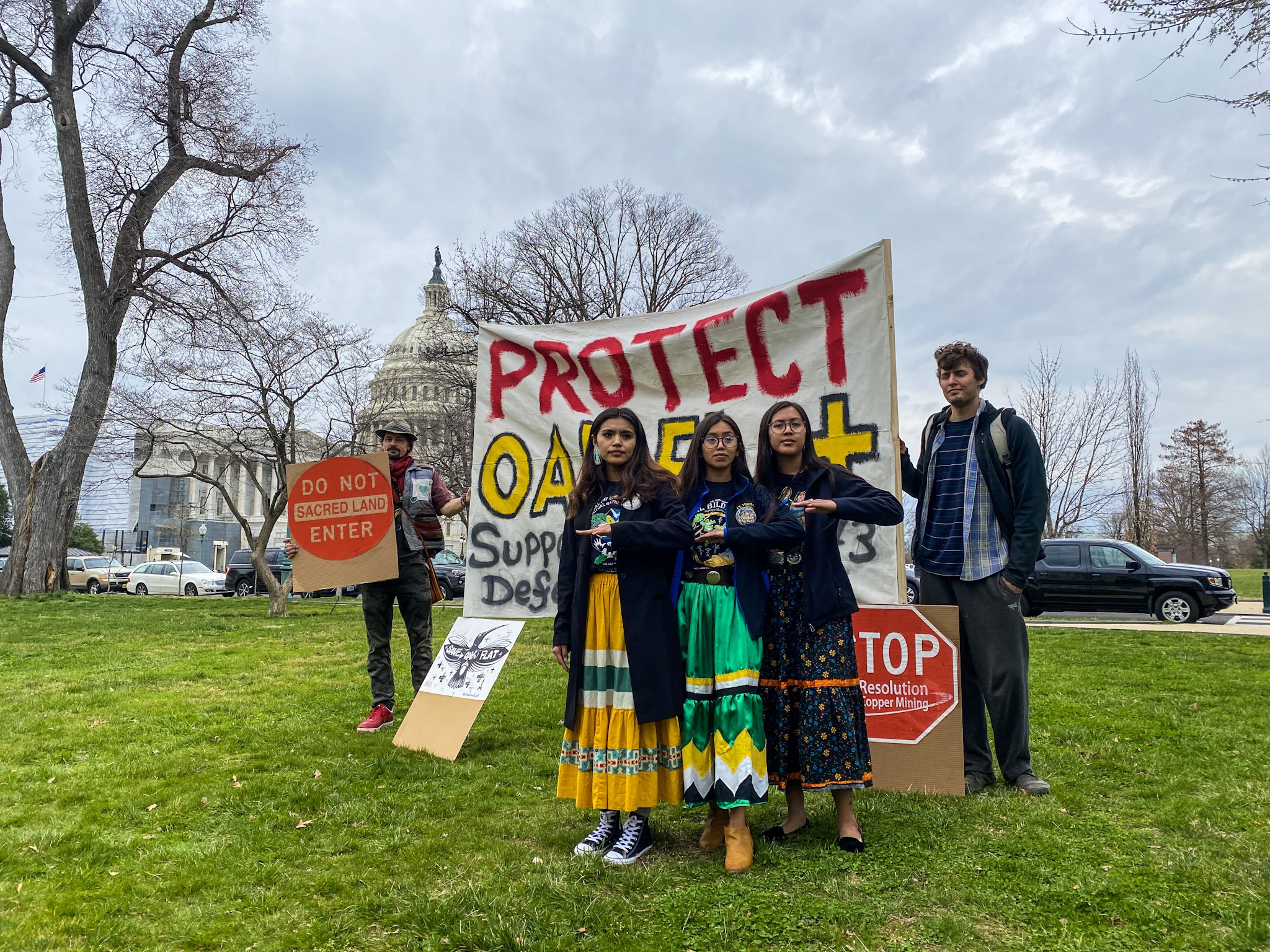
Apache Stronghold v. United States (24-291), another chapter in the
long-running battle to protect a sacred site in Arizona from a massive copper has closed.
But with the U.S. government in shutdown mode, the fight over sacred Oak Flat is far from over. The federal land at issue has yet to be transferred to foreign-controlled mining interests — a move that Justice Neil Gorsuch, one of the more conservative members of the Supreme Court, has already
blasted as unprecedented.
“For centuries, Western Apaches have worshipped at Chí’chil Biłdagoteel, or Oak Flat,” Gorsuch wrote in May, when the
Apache Stronghold, a grassroots organization, asked the court to hear the case on religious freedom grounds.
“No more. Now, the government and a mining conglomerate want to turn Oak Flat into a massive hole in the ground,” added Gorsuch, who to this day remains the only justice with significant experience in Indian law.
Following Gorsuch’s stinging words, the Apache Stronghold went back to the Supreme Court for a second chance at presenting the petition. On Monday, the justices denied the newer petition without a written explanation.
But once again, Gorsuch noted that he wanted to hear the case. This time, however, he did not release a dissent.
“Before allowing the government to destroy the Apaches’ sacred site, this Court should at least have troubled itself to hear their case,” Gorsuch wrote back in May in the
17-page dissent.
And once again, Justice Samuel Alito, another conservative member of the high court, “took no part in the consideration or decision of this petition” according to Monday’s order. No explanation was given — though it’s likely due to possible financial ties to the foreign companies behind
Resolution Copper and the mine at Oak Flat.

Indianz.Com
The land at issue is part of the
Tonto National Forest, about 40 miles west of Phoenix, the largest metropolitan area in Arizona. A federal statute that was widely opposed in Indian Country set in motion the
transfer to Resolution Copper over a decade ago.
But as part of a separate lawsuit filed by the
San Carlos Apache Tribe, the transfer was put on hold by the
9th Circuit Court of Appeals on August 18. Although the
hold is only temporary, Chairman Terry Rambler welcomed the development.
“The Apache people will never stop fighting for Chí’chil Biłdagoteel,” Rambler said. “We thank the court for stopping this horrific land exchange and allowing us to argue the merits of our pending lawsuit in court.”
“We will continue praying that the court understands the grave injustice of trading our sacred grounds to foreign mining companies that seek to destroy Chí’chil Biłdagoteel to extract copper that will be exported overseas,” added Rambler, who said the likely recipient is China.
“It’s a bad deal for our tribe, the state of Arizona and American taxpayers and must be stopped,” Rambler concluded.
Oral arguments have been scheduled for January 7, 2026, in Phoenix. The date was set just five days before the government shutdown.
And just one day before the shutdown, the
Donald Trump administration and
Resolution Copper asked the 9th Circuit to lift the hold on the transfer of the land at Oak Flat. Contrary to the tribe’s claims, they assert the project is essential to “national interests” with the federal government claiming the mine will “ultimately produce up to 25% of the nation’s copper for 40 years.”
The 9th Circuit has not yet taken action on the requests. Meanwhile, President Trump and his administration continue to blame the shutdown on “Radical Left Democrats” even though the Republican party controls both chambers of the U.S. Congress.
The
U.S. Forest Service website claims it can only be updated for “mission critical functions” following the lapse in federal appropriations for fiscal year 2026, which began on October 1. The website for the
Department of Agriculture, the parent agency of the Forest Service, claims it “will not be updated during the funding lapse.”