Indianz.Com > News > ‘Very welcoming and enthusiastic’: Lumbee Tribe awaits word from Washington about federal status

‘Very welcoming and enthusiastic’: Lumbee Tribe awaits word from Washington about federal status
Tuesday, April 22, 2025
Indianz.Com
The Lumbee Tribe is awaiting word from the nation’s capital about its long-running quest for federal recognition.
The Lumbees are a state-recognized group from North Carolina. They have been seeking a formal government-to-government relationship with the United States for more than a century.
“As Chairman, I stand on the shoulders of so many of our ancestors who began this journey in the 1800’s and I take their memories and hard work with me every day,” John L. Lowery, the tribe’s leader, said in an update to Lumbee citizens last week.
According to Lowery, the Department of the Interior (DOI) is preparing a “report” about avenues for extending federal recognition to the Lumbees.
He said he had two “consultation meetings” with officials from the cabinet-level agency in March, following an initial meeting that took place on February 11.
“The DOI officials have been very welcoming and enthusiastic while consulting with us,” Lowery said in the update.
The activity at DOI was set in motion by President Donald Trump. In a memorandum on January 23, he ordered the Secretary of the Interior to come up with a “plan to assist the Lumbee Tribe in obtaining full Federal recognition through legislation or other available mechanisms, including the right to receive full Federal benefits.”
“I love the Lumbee Tribe,” Trump said as he signed the document at the White House, just three days after being sworn in as the 47th president of the United States.
At the time, former North Dakota governor Doug Burgum had not yet been confirmed as Secretary of the Interior, a cabinet-level position. Nonetheless, Trump gave him 90 days to come up with the plan for assisting the Lumbees — a deadline that arrives on April 23, Chairman Lowery pointed out in his update.
“I look forward to the DOI’s report and working with them and Trump Administration
officials to finally get our tribe across this goal line,” Lowery said.
Burgum, who won bipartisan support for his nomination as Secretary, has not publicly spoken about the federal recognition directive from the White House. DOI did not immediately return a request for comment, placed later in the afternoon on Tuesday, about the Lumbee deadline.
But beyond the three meetings that Lowery said he had with DOI, the agency has not engaged in any consultation or outreach with other Indian nations about the Lumbees, according to a policy expert who has been closely monitoring the issue. The Eastern Band of Cherokee Indians, the only federally-recognized tribe headquartered in North Carolina, has long expressed doubts, concerns and outright opposition.
“There are some state groups in the state of North Carolina, that are not federally recognized, that are receiving substantial funds, and we think that is concerning,” Eastern Cherokee Chief Michell Hicks said in Congressional testimony in February.
“They found loopholes within the systems,” Hicks asserted on February 26.
In testimony to lawmakers responsible for writing the appropriations bill that funds DOI, Hicks did not single out the Lumbees by name. But he said Congress should examine why state-recognized groups have been receiving federal funds despite lacking a government-to-government relationship with the U.S.
“We think, you know, as you guys go through this evaluation process, that that would be beneficial to take a peek at, you know, some of these funding levels that are not supporting federally recognized tribes,” Hicks said at a hearing in Washington, D.C.
“But it’s state recognized groups that are achieving some of this funding — and it’s substantial dollars,” Hicks concluded.
Through an initiative called the Department of Government Efficiency, or DOGE, Trump has sought to drastically reduce the size of the executive branch. Countless numbers of employees who served Indian Country have been fired, millions of dollars in grants that funded Indian organizations have been terminated and programs started by the prior administration have all come to a halt over the last 90 days as part of an effort to curtail spending at DOI and other federal agencies by at least $2 trillion.
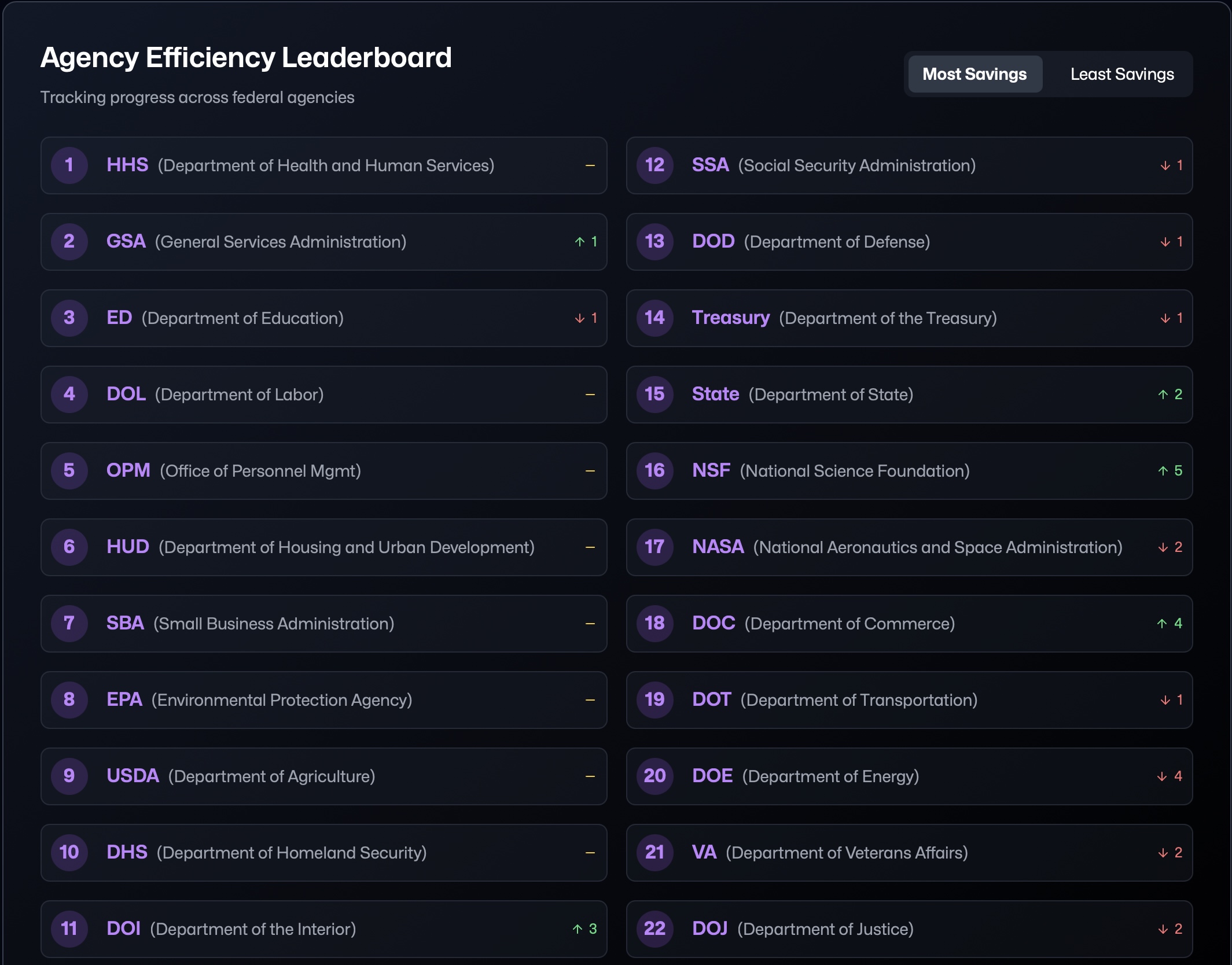
According to doge.gov, DOI is currently ranked 11 out of 22 in terms of “Most Savings.” The agency’s ranking has risen three positions in the “Agency Efficiency Leaderboard” on the website, which was last updated on Sunday but does not contain any details about how much money has supposedly been saved at the agency with the most trust and treaty responsibilities to tribes and their communities.
Extending federal acknowledgment to the Lumbees — who claim a membership of more than 60,000 — might send DOI’s back down the rankings chart. According to the Coalition of Large Tribes (COLT), representing more than 50 tribes in mostly Western states, and the United Indian Nations of Oklahoma (UINO), representing 38 tribes in Oklahoma, Lumbee recognition could cost taxpayers $1.74 billion over the next five years.
The Department of Health and Human Services, which includes the Indian Health Service (IHS), is currently ranked at the top of the doge.gov leaderboard. According to the Congressional Budget Office (CBO), extending IHS care to an estimated 44,000 eligible Lumbee citizens would cost about $1,700 for each person every year, or around $75 million a year.

Related Stories
Search
Filed Under
Tags
More Headlines
Native America Calling: Lumbee Nation secures its sovereign status
Native America Calling: The Year in Native News
Native America Calling: Native music in 2025
Native America Calling: Amid Greenland’s independence push, Denmark accounts for colonial blunders
Senate Committee on Indian Affairs sets business meeting and hearing
Native America Calling: Saving historic architecture and other important places
VIDEO: H.R.2400, the Pit River Land Transfer Act of 2025
VIDEO: H.R.3620, the Southcentral Foundation Land Transfer Act of 2025
VIDEO: H.R.2815, the Cape Fox Land Entitlement Finalization Act of 2025
AUDIO: H.R.2400, the Pit River Land Transfer Act of 2025
AUDIO: H.R.3620, the Southcentral Foundation Land Transfer Act of 2025
AUDIO: H.R.2815, the Cape Fox Land Entitlement Finalization Act of 2025
Native America Calling: Native in the Spotlight with Randy Taylor
NAFOA: 5 Things You Need to Know this Week (December 15, 2025)
Chuck Hoskin: Cherokee Nation celebrates milestone in tribal gaming
More Headlines
Native America Calling: The Year in Native News
Native America Calling: Native music in 2025
Native America Calling: Amid Greenland’s independence push, Denmark accounts for colonial blunders
Senate Committee on Indian Affairs sets business meeting and hearing
Native America Calling: Saving historic architecture and other important places
VIDEO: H.R.2400, the Pit River Land Transfer Act of 2025
VIDEO: H.R.3620, the Southcentral Foundation Land Transfer Act of 2025
VIDEO: H.R.2815, the Cape Fox Land Entitlement Finalization Act of 2025
AUDIO: H.R.2400, the Pit River Land Transfer Act of 2025
AUDIO: H.R.3620, the Southcentral Foundation Land Transfer Act of 2025
AUDIO: H.R.2815, the Cape Fox Land Entitlement Finalization Act of 2025
Native America Calling: Native in the Spotlight with Randy Taylor
NAFOA: 5 Things You Need to Know this Week (December 15, 2025)
Chuck Hoskin: Cherokee Nation celebrates milestone in tribal gaming
More Headlines