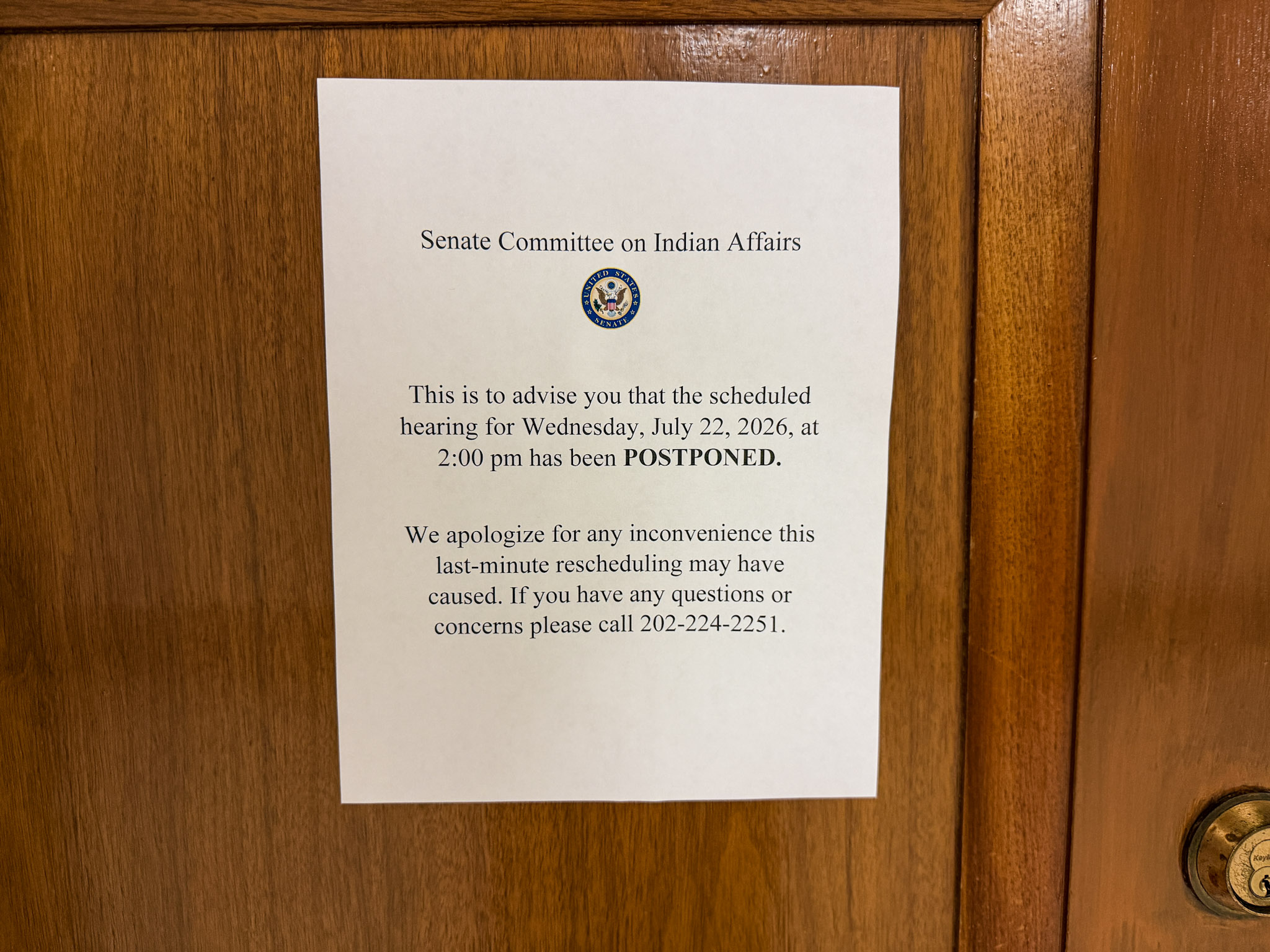
The president’s demand, incidentally, came while the Senate Committee on Indian Affairs was advancing his agenda by taking up his pick to lead the Indian Health Service (IHS). On that same day, Sen. Lisa Murkowski (R-Alaska), the Republican chair, vowed to move quickly on the nomination of Mark Cruz to serve as director of the federal agency charged with delivering health care to more than 2.8 million American Indians and Alaska Natives. “I don’t usually say it before we’ve actually gone through the hearing process, but I am looking forward to supporting your nomination and and working with the vice chairman and our colleagues to move your nomination through the committee,” Murkowski said on June 24. Despite the postponement of NAHASDA hearing amid Murkowski’s absence from Washington, D.C., the committee in fact went ahead with a business meeting to advance Cruz’s nomination last Wednesday. Tribal advocates are hoping the Senate will act before the upcoming recess to fill a leadership position at the IHS that has been vacant for more than 18 months. “IHS needs a confirmed director,” Murkowski told Cruz, a citizen of the Klamath Tribes who currently serves as an adviser to Secretary Robert F. Kennedy Jr., the leader of the Department of Health and Human Services. Murkowski introduced S.4276, the Native American Housing Assistance and Self-Determination Modernization Act of 2026, on March 26. The bipartisan bill has the support of Sen. Brian Schatz (D-Hawaii), the Democratic vice chair of the Senate Committee on Indian Affairs, and six other Democrats and Republicans in the Senate. “After thirteen years of expired authorization, Tribal Nations across Indian Country have never been more unified or more ready — and our message to Congress is clear: the time to reauthorize and modernize NAHASDA is now,” said Mark Macarro, the president of the National Congress of American Indians, the largest inter-tribal advocacy organization. “This legislation honors the legal federal trust responsibility while empowering Tribal Nations to govern themselves and build the homes their communities urgently need. NCAI and the Tribal leaders we represent are fully mobilized to support the House and Senate working together to find compromise.” “Tribal Nations will not stop until Congress gets this done,” said Macarro, who also serves as chair of the Pechanga Band of Indians from California. According to the Senate Committee on Indian Affairs, the NAHASDA bill:“Secretary [Scott] Turner and I remain absolutely committed to working with Congress on reauthorizing NAHASDA”: Congress has failed to reauthorize #NAHASDA since 2013 as @HUDGov and @SecretaryTurner mark #NAHASDA30 milestone. @NCAI1944 @HUD_ONAP #DC pic.twitter.com/sUxuMJEjoy
— indianz.com (@indianz) February 10, 2026
- Reauthorizes the Indian Housing Block Grant and the Native Hawaiian Housing Block Grant through 2033 to provide long-term stability and certainty for Tribal housing and Native Hawaiian housing programs.
- Streamlines environmental reviews, reporting, and federal requirements to reduce delays and accelerate housing development in Tribal and Native Hawaiian communities.
- Expands eligibility and flexibility for Tribal Housing programs, including allowing increased income eligibility for homeownership and enabling pathways such as lease-to-own.
- Codifies the Tribal HUD-VASH program (Housing and Urban Development-VA Supportive Housing) and ensures dedicated resources for Native veterans experiencing or at-risk of homelessness.
- Enhances Tribal self-determination by providing greater control over procurement, rent policies, program design, and use of funds.
- Enhances access to private financing by reauthorizing and improving Section 184 and 184A loan guarantee programs and expanding lender participation.
- Expands Tribal access to federal homelessness programs, including the Continuum of Care program and new Tribal and rural housing initiatives.
- Establishes targeted pilot and demonstration programs to provide housing assistance and supportive services for Native Americans, Alaska Natives, and Native Hawaiians experiencing homelessness.
Downing serves on prominent House Committee on Financial Services, which the NAHASDA bill has been referred to. The Republican from Montana has acknowledged Indian Country’s omission from the larger national housing picture — he responded to NAIHC’s social media posts about the 21st Century ROAD to Housing Act with a promise. “Homeownership is part of the American Dream, and that includes families in tribal communities,” Downing said on social media in response to NAIHC’s post on June 21. “Proud to have introduced the bipartisan NAHASDA Modernization Act to give tribes long-term certainty and more flexibility to meet local housing needs,” Downing said of H.R.8092. “I’ll keep fighting to get it across the finish line.”Homeownership is part of the American Dream, and that includes families in tribal communities.
— Congressman Troy Downing (@RepTroyDowning) June 22, 2026
Proud to have introduced the bipartisan NAHASDA Modernization Act to give tribes long-term certainty and more flexibility to meet local housing needs.
I’ll keep fighting to get it… https://t.co/fayAASkzBH
At midnight, the 21st Century ROAD to Housing Act became law — the most comprehensive federal housing legislation in decades, with 45+ provisions to boost housing supply and affordability nationwide.
— NAIHC (@naihc_national) July 11, 2026
But for Indian Country, the story is incomplete. The new law includes Tribes… pic.twitter.com/KkJzoPiIAj
Testimony: Hilary Atkin, Department of Housing and Urban Development
Testimony: Bryan Warner, Cherokee Nation
VIDEO: H.R.741 – Stronger Engagement for Indian Health Needs Act of 2025
VIDEO: H.R.6021 – Archie Cavanaugh Migratory Bird Treaty Clarification Act
Senate Committee on Indian Affairs takes up Native housing
Native America Calling: Native advocates assess barriers to upcoming elections
Native America Calling: An Indigenous-led opera retells a historic Tlingit act of resistance
Native America Calling: Shifting preservation policies pose risks to Native history
Chuck Hoskin: Cherokee Nation makes tribal government easy to reach
Native America Calling: Persistent heat puts strain on people, the environment, and the economy
Chuck Hoskin: Cherokee Nation creates opportunities close to home
Native America Calling: Increasing hurdles and uncertainty put strains on Native beef producers and farmers
Chuck Hoskin: Cherokee Nation keeps our language alive
‘Let’s go’: Peggy Flanagan wins Democratic primary for U.S. Senate seat in Minnesota
More Headlines