Indianz.Com > News > House of Representatives set to take action on Indian Country bills
House of Representatives set to take action on Indian Country bills
Monday, March 2, 2026
Indianz.Com
The 119th Congress is slowly but surely taking action to advance Indian Country’s legislative agenda following a less than stellar start to the session.
The U.S. House of Representatives is scheduled to pass four pro-tribal bills on Tuesday, according to the Majority Leader’s calendar. All are being considered under a suspension of the rules, a process typically used for non-controversial legislation.
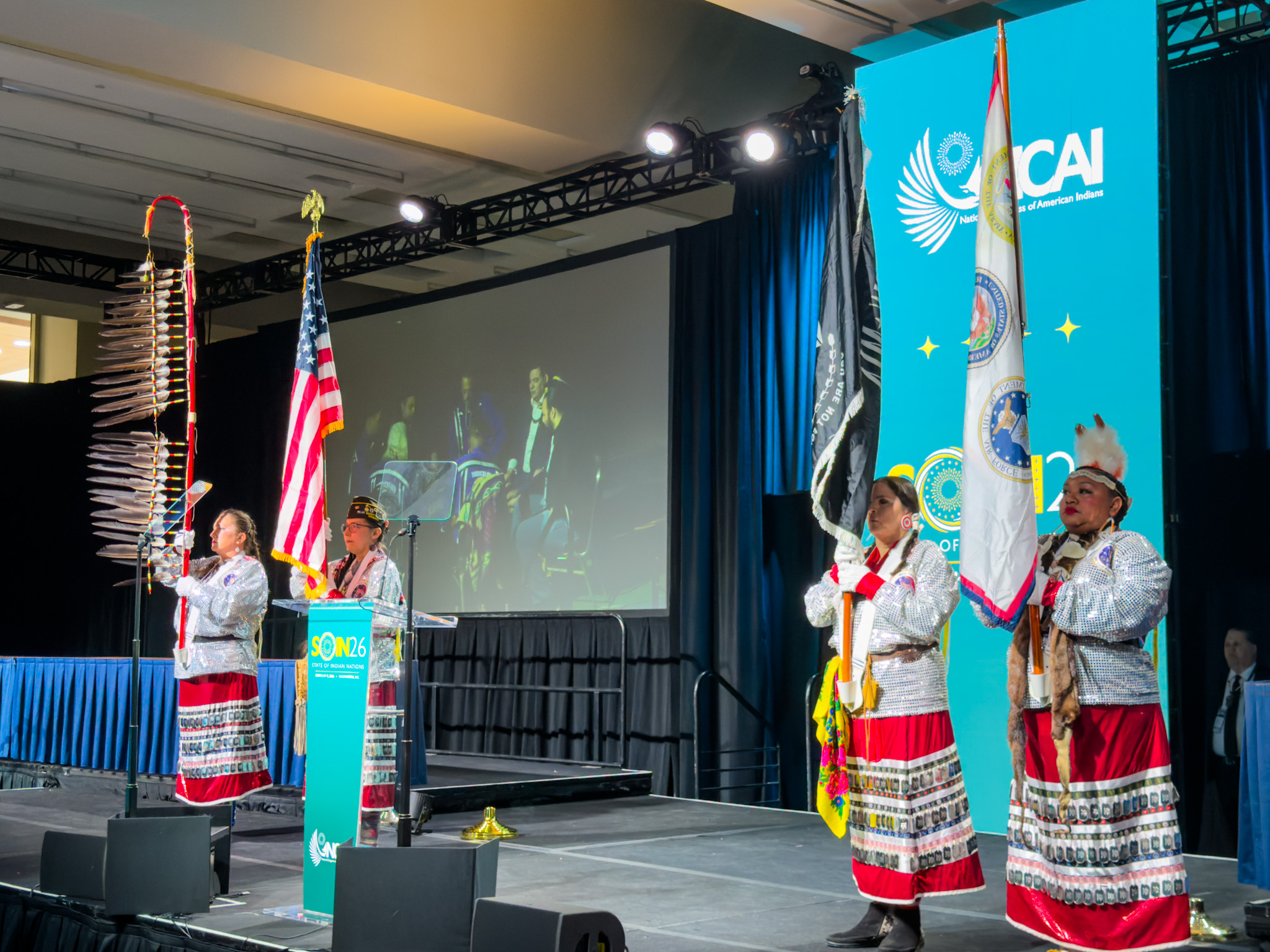
“It’s the work that you have been doing educating us over the decades that makes it possible to not just expect — but demand — that we respect tribal sovereignty,” Rep. Teresa Leger Fernández (D-New Mexico) told tribal leaders last month as the National Congress of American Indians met in Washington, D.C.
“And we respect it and expect it from Democrats and Republicans alike,” noted Leger Fernández, who is the highest-ranking Democrat on the House Subcommittee on Indian and Insular Affairs, the legislative panel where most tribal bills are introduced, heard and advanced on a bipartisan basis.
But since the start of the 119th Congress in January 2025, only a couple of pieces of Indian Country legislation have managed to make it over the finish line — and only because of significant debate. The Wounded Knee Massacre Memorial and Sacred Site Act [H.R.165] finally became law in December after being held hostage for years by a Republican lawmaker in connection with a completely different measure. The Republican, Sen. Thom Tillis (R-North Carolina), was eventually able to secure federal recognition for the Lumbee Tribe in his home state of North Carolina, also in December. But success came only when the Lumbee Fairness Act was added to an unrelated package following years of uncertainty. “This achievement was a true team effort,” said the retiring Tillis, who credited his staff for “breaking a decades-old legislative stalemate and making this historic moment a reality.” With the legislative logjam supposedly cleared, lawmakers on Capitol Hill have a lot of opportunities to live up to the federal government’s trust and treaty responsibilities. More than 20 Indian Country bills are inching closer to passage, including one that is being taken up by the House on Tuesday. The four bills being considered under a suspension of the rules follow: • H.R.5910, a bill to allow tribes to enter into long-term leases and other agreements on their lands for up to 99 years. The measure was approved by the House Committee on Natural Resources on January 14. • H.R.3903, the Chugach Alaska Land Exchange Oil Spill Recovery Act of 2025. The bill authorizes a land exchange between the federal government and Chugach Alaska Corporation, an Alaska Native corporation whose communities were impacted by the Exxon Valdez oil spill on March 24, 1989. A hearing took place before the House Subcommittee on Indian and Insular Affairs on September 9, 2025, and the bill was approved by the House Committee on Natural Resources on November 20, 2025. • H.R.681, a bill to allow the Aquinnah Wampanoag Tribe and the Mashpee Wampanoag Tribe to enter into long-term leases and other agreements on their lands in Massachusetts. A hearing took place before the House Subcommittee on Indian and Insular Affairs on September 9, 2025, and the bill was approved by the House Committee on Natural Resources on November 20, 2025. • S.723, the Tribal Trust Land Homeownership Act of 2025. The bill requires the Bureau of Indian Affairs to process residential and business mortgages on tribal lands within certain deadlines. The Senate Committee on Indian Affairs approved the measure on March 5, 2025. Of the four, only S.723 has already passed the U.S. Senate. Action in the House would clear the bill to be signed into law by President Donald Trump. “As Chairman, I’m proud of our committee’s strong bipartisan work on legislation important to Native peoples,” Sen. Lisa Murkowski (R-Alaska), the Republican leader of the Senate Committee on Indian Affairs, said when S.723 was among 12 bills cleared by the Senate on December 12, 2025. A second bill, H.R.504, the Miccosukee Reserved Area Amendments Act, also had cleared the Senate and the House. But Trump vetoed the measure after claiming that the Miccosukee Tribe in Florida obstructed his immigration agenda.“These are not DEI programs. These are trust responsibilities”: Rep. Teresa Leger Fernandez (D-New Mexico) on US government’s trust and treaty obligations to tribes and their communities at National Congress of American Indians. @NCAI1944 @RepTeresaLF #DC pic.twitter.com/TWj8MRmief
— indianz.com (@indianz) February 10, 2026

‘What is the holdup here?’
Search
Filed Under
Tags
More Headlines
NAFOA: 5 Things You Need to Know This Week (April 13, 2026)
Chuck Hoskin: Cherokee Nation stands up for tribal and rural health care
Native America Callling: Tribes confront growing data center development pressure
Native America Callling: Money management during economic uncertainty and the rise of Buy Now Pay Later
Native America Callling: Roller derby skaters don’t let anyone push them around
Kaiser Health News: Shortfall in Medicaid funds affects Native mothers
Cronkite News: Republicans slam President Trump for Iran war threats
Native America Callling: Tribes scramble to save critical healthcare funding
Native America Callling: Alutiiq Museum tells the story of Alaska Native children sent to Carlisle Indian Boarding School
Press Release: Alaska Federation of Natives objects to controversial voting bill
NAFOA: 5 Things You Need to Know This Week (April 6, 2026)
Chuck Hoskin: Cherokee Nation cares for animals in our community
Native America Callling: What the “conversion therapy” court decision means for LGBTQ2+ protections
Montana Free Press: Tribes lose federal grants in DEI purge at USDA
Fiscal Year 2027 Budget Request: Department of Health and Human Services
More Headlines
Chuck Hoskin: Cherokee Nation stands up for tribal and rural health care
Native America Callling: Tribes confront growing data center development pressure
Native America Callling: Money management during economic uncertainty and the rise of Buy Now Pay Later
Native America Callling: Roller derby skaters don’t let anyone push them around
Kaiser Health News: Shortfall in Medicaid funds affects Native mothers
Cronkite News: Republicans slam President Trump for Iran war threats
Native America Callling: Tribes scramble to save critical healthcare funding
Native America Callling: Alutiiq Museum tells the story of Alaska Native children sent to Carlisle Indian Boarding School
Press Release: Alaska Federation of Natives objects to controversial voting bill
NAFOA: 5 Things You Need to Know This Week (April 6, 2026)
Chuck Hoskin: Cherokee Nation cares for animals in our community
Native America Callling: What the “conversion therapy” court decision means for LGBTQ2+ protections
Montana Free Press: Tribes lose federal grants in DEI purge at USDA
Fiscal Year 2027 Budget Request: Department of Health and Human Services
More Headlines