Indianz.Com > News > Defense bill snubs Indian Country in favor of Lumbee federal recognition
Defense bill snubs Indian Country in favor of Lumbee federal recognition
Monday, December 8, 2025
Indianz.Com
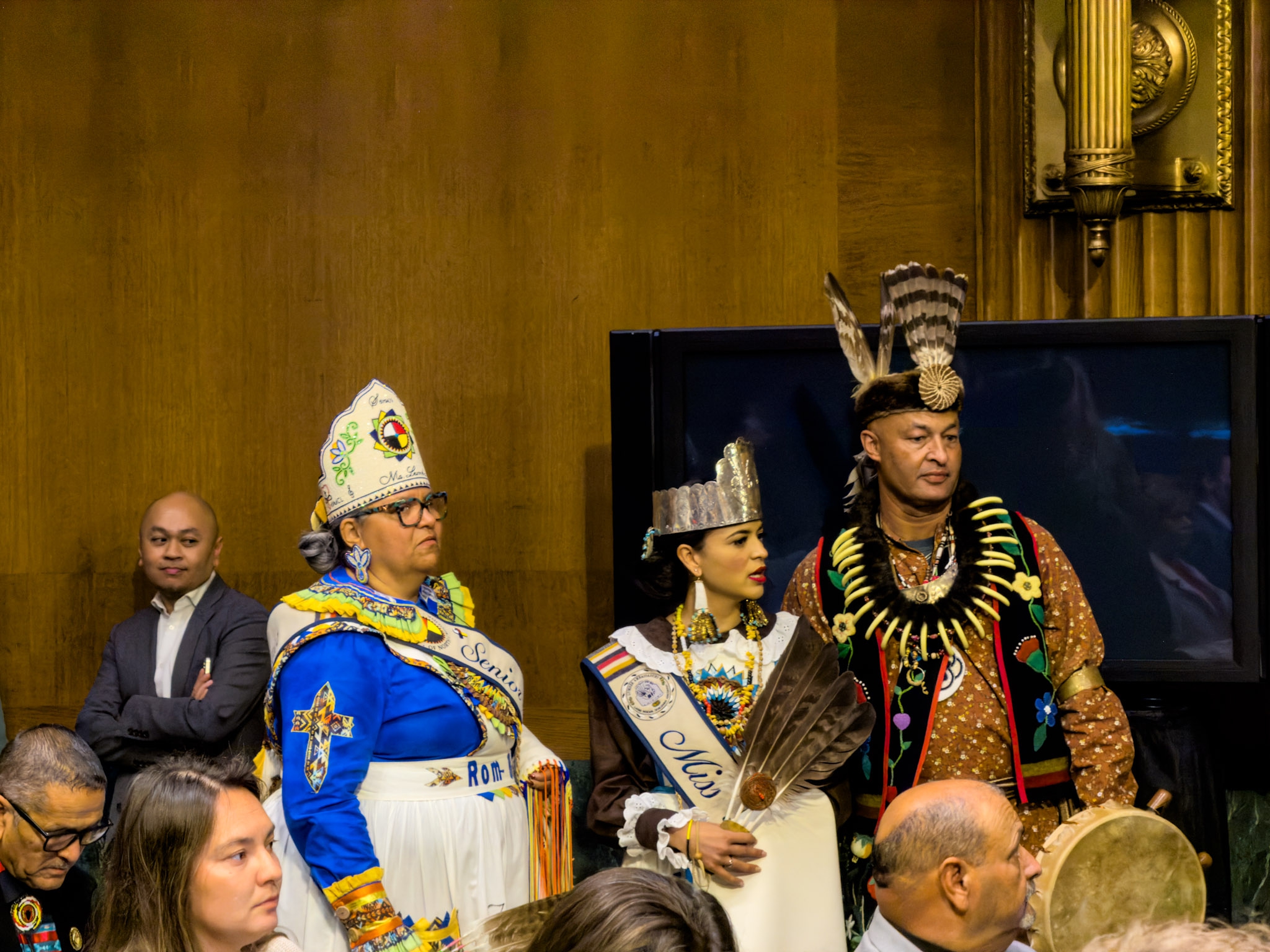
CORRECTION:The current version of the Truth and Healing Commission on Indian Boarding School Policy Act is S.761. The bill was introduced by Sen. Lisa Murkowski (R-Alaska) on February 26, 2025. An earlier version of this story described and linked to a prior version of the bill. Indian Country is on the losing end of the stick with the release of a must-pass defense bill that was negotiated behind closed doors. Tribes and their advocates anticipated the inclusion of several pro-tribal provisions in the National Defense Authorization Act for Fiscal Year 2026. But they learned on Sunday that none of the measures — including one to address the genocidal Indian boarding school era — made it into the final package. In fact, the only provision of interest in the defense bill, commonly known as the NDAA, reflects one of President Donald Trump’s priorities. A controversial measure to extend federal recognition to the Lumbee Tribe in North Carolina can be found in the 3,086-page package — an achievement being credited to the involvement of the White House. “The Lumbee Fairness Act is now included in the final National Defense Reauthorization Act (NDAA) draft heading to votes in the House and Senate in the next two weeks,” Lumbee Chairman John Lowery said on Sunday night, shortly after the text of the measure was released. “We move forward with hope and determination, standing shoulder-to-shoulder with our friends in Congress and the White House to secure final passage,” Lowery continued. “I remain deeply involved every step of the way, helping unite and focus all of our allies as we push toward this long-awaited victory.” “Keep the prayers going up as we know the enemy will continue to fight our efforts,” Lowery said, without explicitly stating the identity of the apparent “enemy.” But as Congress prepares to go home for the Christmas holiday, the Truth and Healing Commission on Indian Boarding School Policy Act is among those on the short end of the stick. The bipartisan bill would begin to hold the United States accountable for the forced removals of children from their tribal communities during the boarding school era. “Last night, our U.S. Truth & Healing bill, along with a few other Native bills, were included in the NDAA,” Deborah Parker, the Chief Executive Officer of the National Native American Boarding School Healing Coalition (NABS), said on Sunday. “By this morning, I was informed only the Lumbee bill is being considered,” said Parker, a citizen of the Tulalip Tribes. The snubbing of Indian Country in the NDAA follows nearly a year of policy setbacks at the national level. From the loss of millions of dollars in federal funds to the longest government shutdown in U.S. history, tribes have seen few achievements in Washington, D.C., whether it be in the executive branch or the legislative — both of which have been controlled by Republicans since the start of 2025. But the inclusion of the Lumbee Fairness Act in the defense bill stands to benefit a group that has closely aligned itself with the Republican movement. From Chairman Lowery’s appearance with President Trump at the White House last week to claims that one of Trump’s five children is Lumbee, the so-called People of the Dark Water made a big bet on the Grand Old Party. “We have used every tool at our disposal to secure recognition in this year’s NDAA,” said Rep. Mark Harris (R-North Carolina), one of the Republican co-sponsors of the Lumbee Fairness Act. “I’m deeply grateful to President Trump for his longstanding championship of the Lumbee Tribe and for working across both chambers of Congress to deliver the full federal recognition and rights our people deserve.” “Now is the time — let’s get it over the finish line!” said Harris. Despite the high-level support, federal recognition for the Lumbees remains highly controversial due to uncertainties about their origins. Over the past century, the group has identified and associated itself with such diverse and divergent Indian groups as the Croatan, the Cherokee and the Tuscarora. “Every sovereign Tribal Nation in this country has been required to prove its identity, lineage, history, and continuous governance,” Principal Chief Michell Hicks of the Eastern Band of Cherokee Indians, said in a statement on Monday. “The Lumbee have not met any of those standards, and their repeated refusal to undergo federal verification threatens the credibility of the entire process.” More recently, the Lumbees settled on claiming descent from the historic Cheraw tribe. Last month, the Senate Committee on Indian Affairs was told that the group is the same as the “Cheraw” people who were living around the present-day Lumber River in North Carolina in the early 1700s. “We have been there ever since. It’s the same community, regardless of the name,” Arlinda Locklear, a Lumbee citizen who has been working on the tribe’s bid for federal recognition for 40 years, told the committee at a hearing in Washington, D.C., on November 5. The Lumbees, however, have struggled to explain how they have maintained their claimed Cheraw identity. At the hearing, Locklear was asked about the group’s language but never provided a direct answer, instead suggesting the federal government is to blame for the lack of knowledge. Locklear said the “noted linguist” Ella Deloria visited the Lumbees “for the purpose of studying the remnants that remained of tribal languages.” Deloria, who was from the Yankton Sioux Tribe in South Dakota, was sent to North Carolina by the U.S. government to study the group, who had yet to adopt the “Lumbee” name. “She made note in 1940 that those remnants existed and her purpose was to establish a dictionary,” Locklear testified. “She did not complete that work because she was not able to get funding.”
Testimony: Legislative Hearing on S.107, the Lumbee Fairness Act
John Lowery | Arlinda Locklear | Michell Hicks | Michell Hicks Exhibits | Ben Barnes | Department of the InteriorSenate Committee on Indian Affairs Video
Senate Committee on Indian Affairs Notice
Legislative Hearing on S.107, the Lumbee Fairness Act (November 5, 2025)
Related Stories
Search
Filed Under
Tags
More Headlines
Native America Calling: Heard Museum art fair and Native culture in miniature
Native America Calling: Taxes, roads, and law enforcement: how tribes are asserting their sovereign rights
Native America Calling: Fighting to preserve hard-won gains in K-12 lessons about Native Americans
Press Release: Sovereignty Symposium XXXVIII set for June 2026 in Oklahoma
Native America Calling: Proximity and family outreach hold promise for tribal addiction treatment
House of Representatives set to take action on Indian Country bills
House Subcommittee on Indian and Insular Affairs sets hearing on three bills
NAFOA: 5 Things You Need to Know This Week (March 2, 2026)
Tom Cole: Getting ready for another storm season
Chuck Hoskin: Cherokee Nation builds a stronger future
Native America Calling: Native crews help solve the growing marine trash problem
Native America Calling: Native Playlist with Cary Morin and Status/Non-Status
Native America Calling: Native Hawaiians work to save birds with rich ecological and cultural significance
Native America Calling: Commod Bods, a standout frybread stand and Afro-Indigenous mutual aid
Press Release: Navajo Nation Council mourns passing of Rex Lee Jim
More Headlines
Native America Calling: Taxes, roads, and law enforcement: how tribes are asserting their sovereign rights
Native America Calling: Fighting to preserve hard-won gains in K-12 lessons about Native Americans
Press Release: Sovereignty Symposium XXXVIII set for June 2026 in Oklahoma
Native America Calling: Proximity and family outreach hold promise for tribal addiction treatment
House of Representatives set to take action on Indian Country bills
House Subcommittee on Indian and Insular Affairs sets hearing on three bills
NAFOA: 5 Things You Need to Know This Week (March 2, 2026)
Tom Cole: Getting ready for another storm season
Chuck Hoskin: Cherokee Nation builds a stronger future
Native America Calling: Native crews help solve the growing marine trash problem
Native America Calling: Native Playlist with Cary Morin and Status/Non-Status
Native America Calling: Native Hawaiians work to save birds with rich ecological and cultural significance
Native America Calling: Commod Bods, a standout frybread stand and Afro-Indigenous mutual aid
Press Release: Navajo Nation Council mourns passing of Rex Lee Jim
More Headlines