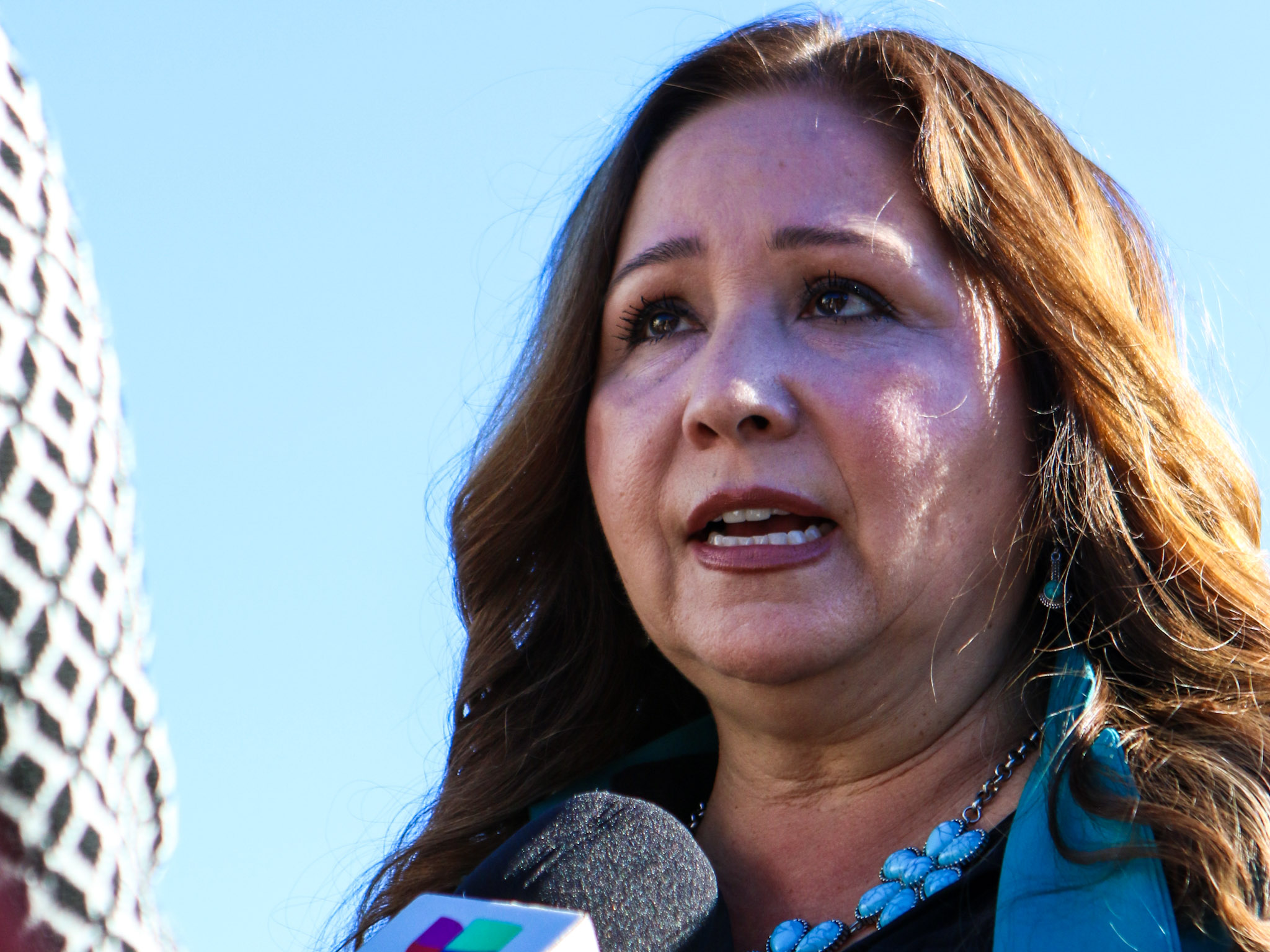
WASHINGTON — Four weeks after Adelita Grijalva won a special congressional election, the state of Arizona sued the U.S. House of Representatives on Tuesday to force Speaker Mike Johnson to swear her in.
The lawsuit accuses him of illegally refusing to seat the Tucson Democrat – who won her late father’s seat by a landslide on September 23 – silencing Arizona voters and depriving the state of its full voice in Congress.
Arizona Attorney General Kris Mayes announced the lawsuit a few hours after Grijalva made her second attempt to take the oath by showing up on the House floor without the speaker’s invitation.
“Speaker Johnson has not identified any valid reason for refusing to promptly seat Ms. Grijalva,” the lawsuit says, asserting that his motive is to delay a vote on releasing the Epstein files and “strengthen his hand” in the budget stalemate that triggered the ongoing government shutdown.
“Constitutional rights cannot be used as a bargaining chip,” the lawsuit says.
Grijalva won nearly 70% of the vote to succeed her father, 12-term Rep. Raúl Grijalva, who died in March.
Johnson’s office did not immediately respond to the lawsuit, which was filed with the U.S. District Court for the District of Columbia. He shrugged off the suit when approached by an MSNBC reporter.
“I think it’s patently absurd. We run the House. She has no jurisdiction. We’re following the precedent. She’s looking for national publicity. Apparently she’s gotten some of it, but good luck with that,” he said.

The speaker has refused to swear in Grijalva until Senate Democrats accept a GOP spending plan to end the shutdown.
He has kept the House out of session since September 19, other than a few brief pro forma sessions at which no business is conducted, including the one on Tuesday.
“This case is about whether someone duly elected to the House … may be denied her rightful office simply because the Speaker has decided to keep the House out of `regular session,’” the lawsuit says. “If the Speaker were granted that authority, he could thwart the peoples’ choice of who should represent them in Congress.”

There is no rule that precludes a swearing-in during a shutdown, a pro forma session or even during a recess.
Typically, only the speaker administers the oath, though he can designate the duty to another House member.
“Speaker Mike Johnson is actively stripping the people of Arizona of one of their seats in Congress and disenfranchising the voters of Arizona’s 7th Congressional District in the process,” Mayes said in a statement, accusing Johnson of treating Arizonans “as second-class citizens in their own democracy.”
Grijalva said the delay goes “far beyond petty partisan politics – it’s an unlawful breach of our Constitution and the democratic process.”
Grijalva has said she intends to sign a petition forcing a vote on release of the full investigative files involving convicted sex trafficker Jeffrey Epstein.
Her signature is the last one needed to circumvent Johnson’s refusal to put the issue on the House floor. She accused him of delaying her oath to “shield this administration from accountability and block justice for the Epstein survivors.”
March 13: Twelve-term Rep. Raúl Grijalva dies at age 77 after a battle with cancer. Adelita Grijalva launches her bid to succeed her father two weeks later. She sails through the July 15 Democratic primary.
September 19: The House approves a stopgap plan to avert a government shutdown. The speaker then dismisses the House except for occasional pro forma sessions at which no business is conducted.
September 23: Adelita Grijalva wins the special election with nearly 70% of the vote.
September 30: Grijalva, now a representative-elect, appears on the House floor during a pro forma session hoping to take the oath of office. Republicans adjourn in less than three minutes despite chants of “Swear her in!” from Democrats.
October 1: Government shutdown begins. It would become the second longest in U.S. history after a 35-day impasse in 2018 and 2019.
October 6: House Speaker Mike Johnson rejects criticism that he is treating Grijalva differently from two Florida Republicans he swore in during pro forma sessions. He made a “unique exception” because their ceremonies were scheduled during full sessions that were cut short unexpectedly, he says.
October 7: Johnson tells reporters he’s willing to swear in Grijalva “as soon as she wants,” though he and aides quickly walk that back, reiterating his condition that Democrats must first approve the GOP plan to end the shutdown.
October 8: Arizona Sens. Ruben Gallego and Mark Kelly engage in a heated exchange with Johnson outside his office. Gallego accuses him of delaying the swearing-in because Grijalva will sign a petition forcing a vote to release the Epstein files. “Stop covering up for the pedophiles,” Gallego says. Calling that “totally absurd,” Johnson blames the Grijalva delay on them and their fellow Senate Democrats.
October 14: Arizona Attorney General Kris Mayes threatens legal action if Johnson doesn’t swear in Grijalva “without further delay.” She gives him three days to comply. That same day, she, Gov. Katie Hobbs and Secretary of State Adrian Fontes certify the September 23 special election.
October 15: Grijalva appears with Arizona’s senators and other allies at the Capitol to condemn the ongoing delay. “Is it because she’s a Democratic Latina?” said a leader of the Congressional Hispanic Caucus.
October 16: Johnson defends the delay by citing what he calls the “Pelosi precedent.” Rep. Julia Letlow, R-La., waited 25 days to be sworn in after a March 2021 special election. Letlow replaced her husband, who had died of COVID-19 before taking office.
In the lawsuit, Mayes notes that Speaker Nancy Pelosi consulted with Letlow and they picked a date the incoming lawmaker requested.
October 17: The deadline Mayes set passes without a swearing-in or legal action against the speaker. House Minority Leader Hakeem Jeffries sends Johnson an open letter demanding he relent.
October 18: Day 25 since Grijalva’s election, matching the pandemic-era delay for Letlow.
October 21: Grijalva’s second attempt to be sworn in during a pro forma session fails.
“While we’re getting a lot of attention for not being sworn in, I’d rather get the attention for doing my job,” she told reporters moments later.
Johnson spoke to reporters beforehand.
“We are not in legislative session,” he said. “The chronology is important. Rep. Grijalva won her race … after we had already gone out of session. So I will administer the oath to her, I hope, on the first day we come back (into) legislative session. I’m willing and anxious to do that.”
Later that afternoon, Mayes announced the lawsuit.
This article first appeared on Cronkite News and is republished here under a Creative Commons Attribution-NoDerivatives 4.0 International License.
For more stories from Cronkite News, visit cronkitenews.azpbs.org.Testimony: Hilary Atkin, Department of Housing and Urban Development
Testimony: Bryan Warner, Cherokee Nation
VIDEO: H.R.741 – Stronger Engagement for Indian Health Needs Act of 2025
VIDEO: H.R.6021 – Archie Cavanaugh Migratory Bird Treaty Clarification Act
Senate Committee on Indian Affairs takes up Native housing
Native America Calling: Native advocates assess barriers to upcoming elections
Native America Calling: An Indigenous-led opera retells a historic Tlingit act of resistance
Native America Calling: Shifting preservation policies pose risks to Native history
Chuck Hoskin: Cherokee Nation makes tribal government easy to reach
Native America Calling: Persistent heat puts strain on people, the environment, and the economy
Chuck Hoskin: Cherokee Nation creates opportunities close to home
Native America Calling: Increasing hurdles and uncertainty put strains on Native beef producers and farmers
Chuck Hoskin: Cherokee Nation keeps our language alive
‘Let’s go’: Peggy Flanagan wins Democratic primary for U.S. Senate seat in Minnesota
More Headlines