Indianz.Com > News > Supreme Court orders another look at Native voting rights case

Supreme Court orders another look at Native voting rights case
Monday, May 18, 2026
Indianz.Com
The U.S. Supreme Court continues to upend the voting rights landscape amid a crucial election cycle that already has tribes and their advocates worried about their power at the polls.
This time, the highest court in the land finally took action on a long-delayed Native voting rights case from North Dakota. In an order on Monday, the justices gave new life to a dispute in which tribes and tribal citizens are challenging a legislative map that they say is illegal.
But unlike a recent decision that has Native advocates reeling, the move in
Turtle Mountain Band of Chippewa Indians v. Howe is being seen as a positive. Attorneys representing tribal plaintiffs are hoping to prove they are right when the case returns to the Eighth Circuit Court of Appeals for further litigation.
“The Supreme Court was correct to vacate the Eighth Circuit’s decision, which wrongly prevented Native voters and Tribal Nations from vindicating their rights under the Voting Rights Act,” Lenny Powell, a staff attorney with the Native American Rights Fund (NARF), said in a news release on Monday.
“On remand, we will keep fighting to ensure that Native voters have the ability to vote and effect change in their communities,” said Powell, who is a citizen of the Hopland Band of Pomo Indians.
The order comes more than eight months after the Native plaintiffs in Turtle Mountain Band of Chippewa Indians v. Howe formally asked the Supreme Court to take up the case. The Turtle Mountain Band of Chippewa Indians, the Spirit Lake Nation and individual tribal voters argued that the Eighth Circuit got it wrong by limiting their ability to sue under the Voting Rights Act, a civil rights era law that has faced renewed scrutiny from Republican politicians.
But instead of taking action on the petition in Howe, the Supreme Court kept delaying consideration, all without providing an explanation even though briefing was completed back in October 2025 for Docket No. 25-253.
Meanwhile, the justices heard and decided Louisiana v. Callais, a closely watched case from Louisiana. Last month, the court — by a vote of 6 to 3 — gutted the protections of the Voting Rights Act, according to NARF and the National Congress of American Indians (NCAI).
“When a Tribal Nation or Native American community’s political voice is diluted, so is its ability to secure good schools, adequate infrastructure, health care access, environmental protections, and economic opportunity, NCAI and NARF said in a joint statement on April 29. “Taking away voting protections, like what happened with today’s decision, makes it harder and at times impossible for Native voters to elect representatives who will respond to their needs.”
In North Dakota, tribes and tribal voters argue that their voice has been weakened by the contested legislative map. Historically, Turtle Mountain and Spirit Lake voters have been able to send three candidates of their choice to the State Legislature, according to the Campaign Legal Center, a non-partisan group that is also part of the litigation.
But immediately following the adoption of the map in 2021, Native voters in the northeastern part of the state were only able to elect one of their preferred candidates to the North Dakota House instead of the usual two. And none were elected to the North Dakota Senate where in the past there had been one chosen.
The landscape began to change as a result of the litigation. In January 2024, a court-ordered map was implemented and later in the year, Turtle Mountain and Spirit Lake voters elected three of their preferred candidates. Elsewhere in the state, voters from the Mandan, Hidatsa and Arikara Nation retained their preferred candidate.
The picture shifted yet again following an appeal by the state of North Dakota. In May 2025, the Eighth Circuit ruled that private parties — such as tribes and individual Native voters — cannot bring a lawsuit to enforce the Voting Rights Act.

 youtu.be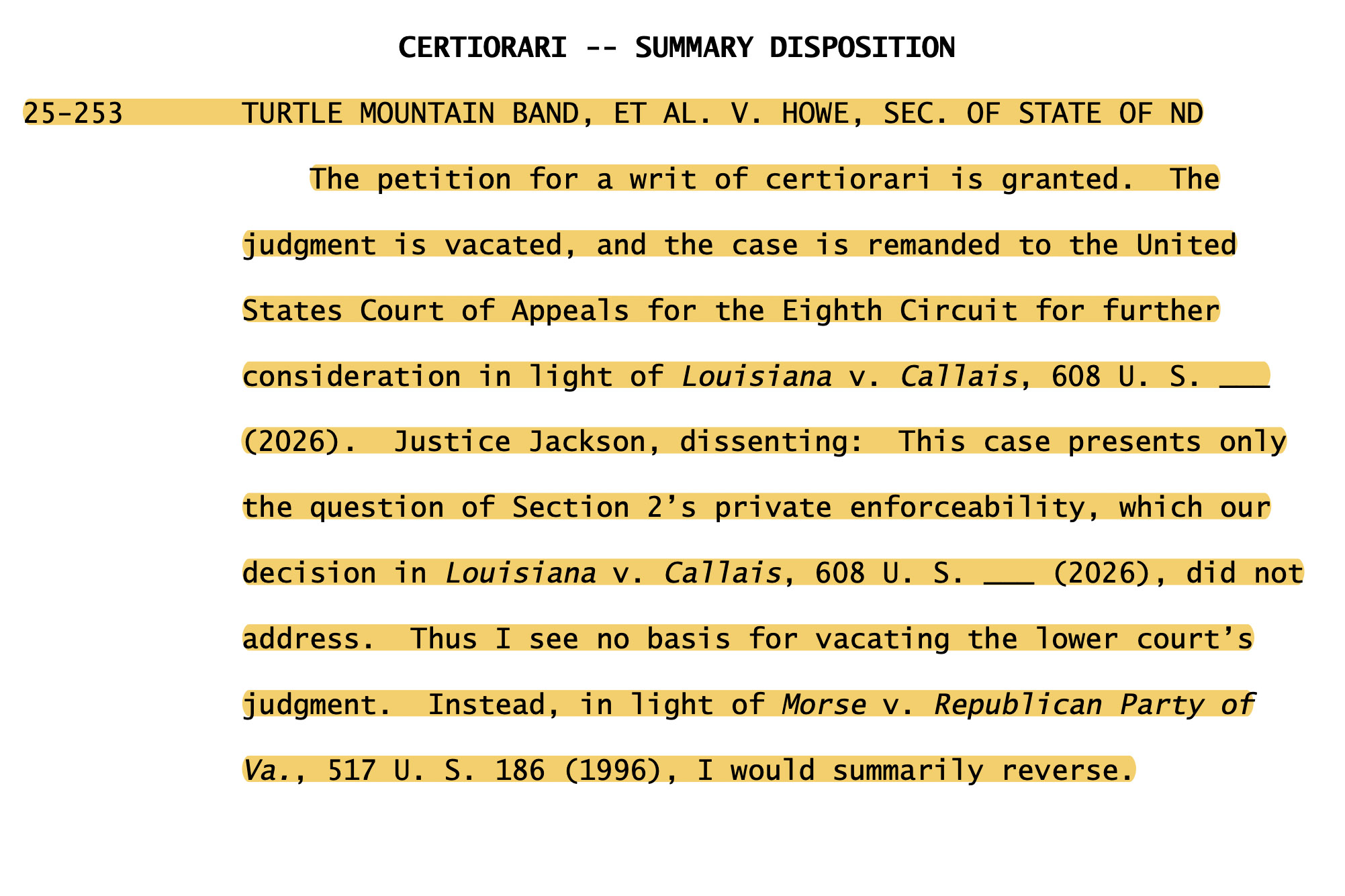
McCoy also pointed out that the justices haven’t heard any Indian law cases for two terms in a row. But she warned that dangers remain for tribes and their citizens when it comes to their fundamental rights. “We have a court that is still very hostile to tribal sovereignty,” said McCoy, attributing it to “some members” of the court. “We have other members who are very appreciative of tribal sovereignty, but it’s really, you know, a wild card with this court,” McCoy added. As the Howe case continues, NARF and NCAI are observing a major milestone of the Tribal Supreme Court Project. In March, the two organizations released a 25th anniversary report that cited the reversal of the win-loss record. A celebration is scheduled to take place September 17-18 in Washington, D.C.“We still need to do more”: Melody McCoy currently leads the Tribal Supreme Court Project. @NCAI1944 and @NDNRights are celebrating 25th anniversary of initiative to help tribes with Supreme Court cases. Anniversary report coming later this year. #DC pic.twitter.com/5HFILMVAwx
— indianz.com (@indianz) February 11, 2026
Related Stories
Search
Filed Under
Tags
More Headlines
Native America Calling: Alaska Native advocates cite shortcomings in addressing MMIP crisis
Native America Calling: Alaska Native leadership and land rights advocacy through the generations
Native America Calling: Native in the Spotlight with Gabriella Cázares-Kelly
Native America Calling: How a young Ponca activist shaped the future of Native activism
Native America Calling: Tribes remain excluded from some major water policy decisions
Native America Calling: Assessing college campus safety in light of troubling allegations at Cornell University
Native America Calling: Native authors and book sellers reflect on a record year for banned books
Native America Calling: Native Playlist with Jeremy Dutcher and Mali Obomsawin
Native America Calling: What removing questions about race from the U.S. Census means for Native Americans
Chuck Hoskin: Cherokee Nation employees serve their communities
Native America Calling: One tribe breaks from the pack on prediction markets
Native America Calling: Finding success through the art of contemporary horsemanship
Testimony: Stephanie Bryan, Poarch Band of Creek Indians
Testimony: Michell Hicks, Eastern Band of Cherokee Indians
Testimony: Mark Macarro, Pechanga Band of Indians
More Headlines
Native America Calling: Alaska Native leadership and land rights advocacy through the generations
Native America Calling: Native in the Spotlight with Gabriella Cázares-Kelly
Native America Calling: How a young Ponca activist shaped the future of Native activism
Native America Calling: Tribes remain excluded from some major water policy decisions
Native America Calling: Assessing college campus safety in light of troubling allegations at Cornell University
Native America Calling: Native authors and book sellers reflect on a record year for banned books
Native America Calling: Native Playlist with Jeremy Dutcher and Mali Obomsawin
Native America Calling: What removing questions about race from the U.S. Census means for Native Americans
Chuck Hoskin: Cherokee Nation employees serve their communities
Native America Calling: One tribe breaks from the pack on prediction markets
Native America Calling: Finding success through the art of contemporary horsemanship
Testimony: Stephanie Bryan, Poarch Band of Creek Indians
Testimony: Michell Hicks, Eastern Band of Cherokee Indians
Testimony: Mark Macarro, Pechanga Band of Indians
More Headlines