Indianz.Com > News > National Council of Urban Indian Health: ‘The government attempted to wipe out our Native cultures’
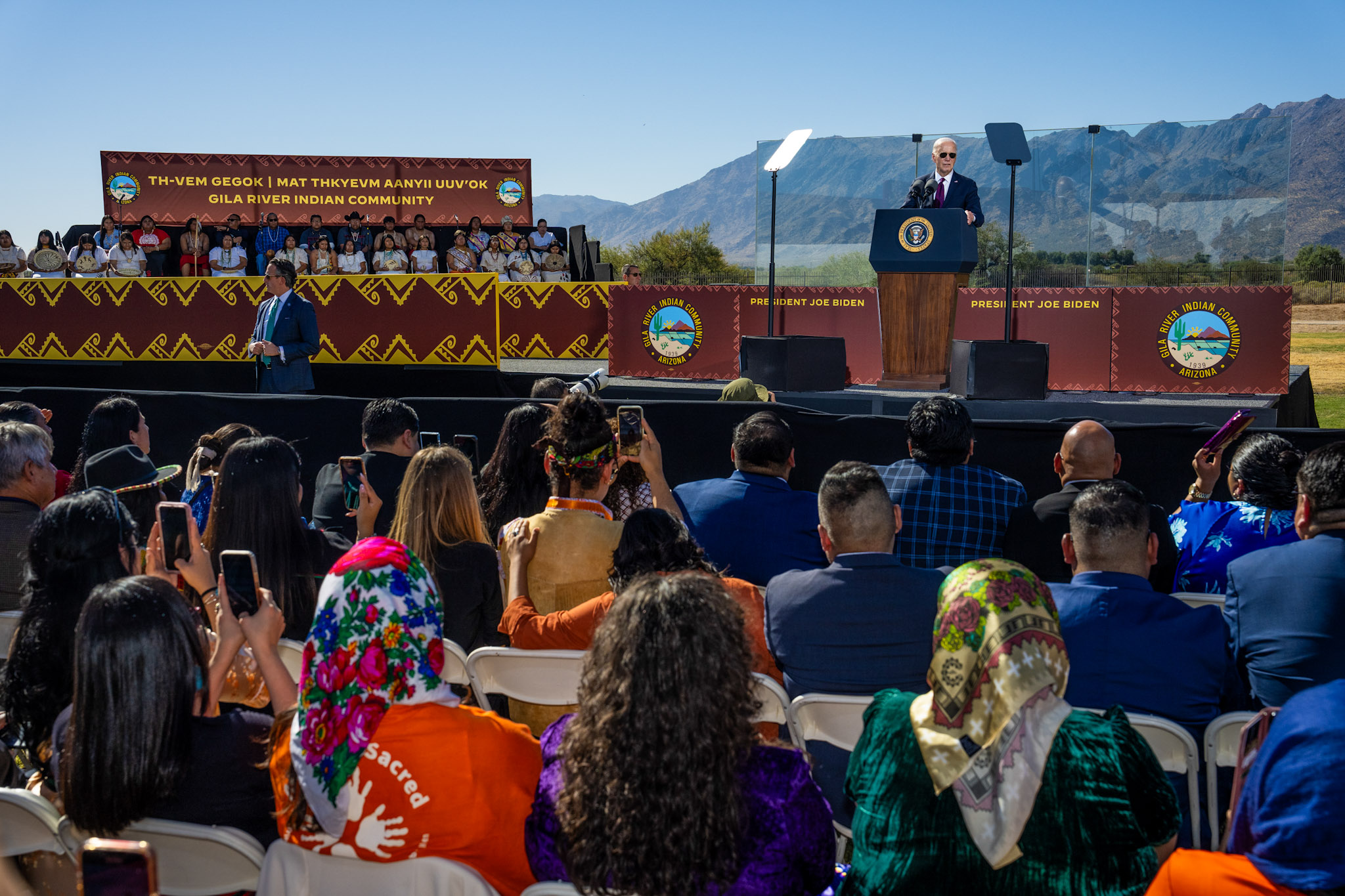
President Biden Formally Apologizes for Federal Government Involvement in Indian Boarding Schools
Monday, October 28, 2024
Indianz.Com
Gila River Indian Reservation, Arizona — President Joe Biden delivered a historic formal apology on behalf of the federal government for its 150-year policy of forcibly placing Native children in Indian Boarding Schools.
“The Federal Indian Boarding School policy and the pain it has caused will always be a significant mark of shame, a blot on American history,” said President Biden in historic remarks. “It’s a sin on our [Nation’s] soul.”
“For 150 years, the government attempted to wipe out our Native cultures by removing and relocating thousands of Native children to boarding schools. The President’s historic apology is a painful reminder of this country’s history and our community’s immense resilience,” said Francys Crevier, J.D. (Algonquin), CEO of NCUIH. “Congress needs to act now and pass the Truth and Healing Commission on Indian Boarding Schools Act, so we can learn from our past and make sure these wrongs are never repeated.”
President Biden’s apology follows the Department of Interior’s (DOI) investigative report, which confirms that at least 973 American Indian, Alaska Native, and Native Hawaiian children died while attending federally operated or supported schools and identifies at least 74 marked and unmarked burial sites at 65 different school grounds. It estimates that the U.S. government appropriated more than $23.3 billion between 1971 and 1969 for the federal Indian boarding school system and other similar institutions and associated assimilation policies (dollars adjusted for inflation based on Fiscal Year 2023).
This act of recognition can foster healing and reconciliation, which are crucial for improving mental and physical health. By validating the experiences of Indigenous peoples and addressing the traumas associated with these institutions, the apology may encourage increased access to health care resources, culturally competent care, and a greater focus on mental health support. Ultimately, such measures can help bridge the gap in health disparities and promote overall well-being within these communities.
NCUIH is particularly grateful to the Native American Boarding School Healing Coalition (NABS) for its unrelenting leadership in securing the DOI’s report and introducing critical legislation in Congress.
Next Steps
Congress must swiftly pass the Truth and Healing Commission on Indian Boarding School Policies in the United States Act. [S.1723 / H.R.7227]
About NCUIH
The National Council of Urban Indian Health (NCUIH) is a national representative advocating for the 41 Urban Indian Organizations contracting with the Indian Health Service under the Indian Health Care Improvement Act. NCUIH is devoted to the support and development of quality, accessible, and culturally competent health and public health services for American Indians and Alaska Natives living in urban areas. NCUIH respects and supports Tribal sovereignty and the unique government-to-government relationship between our Tribal Nations and the United States. NCUIH works to support those federal laws, policies, and procedures that respect and uplift Tribal sovereignty and the government-to-government relationship. NCUIH does not support any federal law, policy, or procedure that infringes upon or in any way diminishes Tribal sovereignty or the government-to-government relationship.
Search
Filed Under
Tags
More Headlines
Testimony: Alicia Puente Cackley, Government Accountability Office
Testimony: Hilary Atkin, Department of Housing and Urban Development
Testimony: Bryan Warner, Cherokee Nation
VIDEO: H.R.741 – Stronger Engagement for Indian Health Needs Act of 2025
VIDEO: H.R.6021 – Archie Cavanaugh Migratory Bird Treaty Clarification Act
Senate Committee on Indian Affairs takes up Native housing
Native America Calling: Native advocates assess barriers to upcoming elections
Native America Calling: An Indigenous-led opera retells a historic Tlingit act of resistance
Native America Calling: Shifting preservation policies pose risks to Native history
Chuck Hoskin: Cherokee Nation makes tribal government easy to reach
Native America Calling: Persistent heat puts strain on people, the environment, and the economy
Chuck Hoskin: Cherokee Nation creates opportunities close to home
Native America Calling: Increasing hurdles and uncertainty put strains on Native beef producers and farmers
Chuck Hoskin: Cherokee Nation keeps our language alive
‘Let’s go’: Peggy Flanagan wins Democratic primary for U.S. Senate seat in Minnesota
More Headlines
Testimony: Hilary Atkin, Department of Housing and Urban Development
Testimony: Bryan Warner, Cherokee Nation
VIDEO: H.R.741 – Stronger Engagement for Indian Health Needs Act of 2025
VIDEO: H.R.6021 – Archie Cavanaugh Migratory Bird Treaty Clarification Act
Senate Committee on Indian Affairs takes up Native housing
Native America Calling: Native advocates assess barriers to upcoming elections
Native America Calling: An Indigenous-led opera retells a historic Tlingit act of resistance
Native America Calling: Shifting preservation policies pose risks to Native history
Chuck Hoskin: Cherokee Nation makes tribal government easy to reach
Native America Calling: Persistent heat puts strain on people, the environment, and the economy
Chuck Hoskin: Cherokee Nation creates opportunities close to home
Native America Calling: Increasing hurdles and uncertainty put strains on Native beef producers and farmers
Chuck Hoskin: Cherokee Nation keeps our language alive
‘Let’s go’: Peggy Flanagan wins Democratic primary for U.S. Senate seat in Minnesota
More Headlines