Indianz.Com > News > Indigenously: The realities of the Native vote
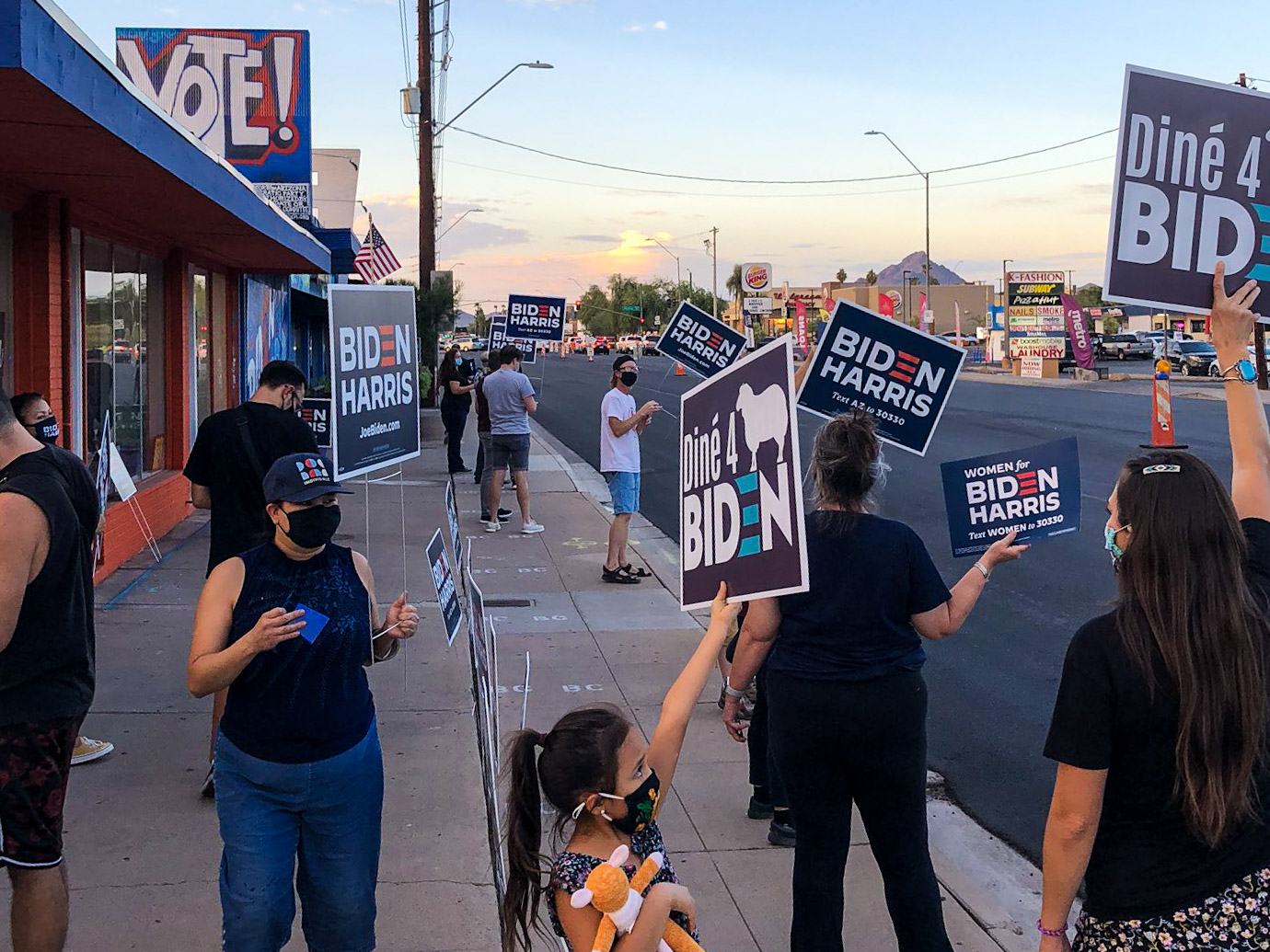
The Native Vote Is Not Code for “Navajo”
Among Arizona’s Indigenous electorate, the biggest support for Joe Biden came from a county no one’s talking about.
Monday, November 23, 2020
Indigenously
This story is a project of the Indigenously newsletter. Subscribe today.
For Native voters, this election year has dealt us one disappointing data dilemma after another.
It began weeks leading up to Election Day when journalists casually cast us off as a “low voter turnout” population but with little modern evidence to support these claims. On Election Night, we were quickly othered into a “Something Else” category with nearly zero attention paid to the small but significant impact Native voters, everywhere, have had in past elections.
And now, in an attempt to seemingly correct these disparities, the headlines read one thing — “Native Voters” — while the content is overwhelmingly fixated on another: the Navajo Nation.

• In five of the most heavily populated counties for Native Americans in Arizona — Apache, Navajo, Coconino, Pinal, and Pima counties — approximately 84-thousand registered Native voters cast ballots in 70 reservation-based precincts with an average of 55 percent choosing Biden.
• The strongest support for Biden, per capita, came from the little-discussed Tohono O’odham Nation in Pima County where voters allege their sacred sites were destroyed by border wall construction, earlier this year. A total of 3,085 votes cast across nine of the reservation’s precincts resulted in 88.6 percent of the vote for Biden.
• Similarly, Native voters in Pinal County, south of Phoenix, outpaced Navajo voters where a total of 2,548 ballots were cast from the Gila River Indian Community, the Ak Chin Indian Community, and the northern tip of the Tohono O’odham Nation — all overwhelmingly in favor of Biden: 86.3 percent. (A portion of a fourth tribal community in the county, the San Carlos Apache Tribe, voted in a separate county.) Below, maps show the stark representation of Native voters — the blue sections reflect precincts on tribal lands, the red ones are non-reservation precincts.
• Arizona’s largest Indigenous electorate — Navajo voters — cast an estimated 54-thousand reservation-based ballots, to which an average 80 percent of their votes went for Biden. Apache County threw the largest support for the President-Elect, roughly 21,000 votes or 82.3 percent of the total vote count.
• Native voter turnout in Arizona was up by an average five percent across all precincts. But the widely overlooked Hopi Tribe in Coconino County made the biggest leap, nearly doubling representation at the polls from 37 percent in 2016 to roughly 60 percent this election cycle.
It’s worth mentioning that Native American voters obviously live in urban cities, too, including in the battleground Maricopa County, home to Phoenix. Considered one of the largest Native urban populations in America, the Indigenous electorate represented an estimated 82-thousand people of voting age this election cycle, or roughly three percent of the county’s eligible voting population. However, as one organizer mentioned recently in the Santa Fe Reporter, unlike reservation-based precincts, tracking the urban Native vote is next to impossible. Only four states in the country — Alabama, Georgia, North Carolina, and South Carolina — record voter registration by race, perhaps a dynamic that should change.

Jenni Monet is a journalist and tribal citizen of the Pueblo of Laguna. She reports on Indigenous rights and injustice in the U.S. and the world. This article originally appeared independently at Indigenously.
Search
Filed Under
Tags
More Headlines
Native America Calling: Native Playlist with Jeremy Dutcher and Mali Obomsawin
Native America Calling: What removing questions about race from the U.S. Census means for Native Americans
Chuck Hoskin: Cherokee Nation employees serve their communities
Native America Calling: One tribe breaks from the pack on prediction markets
Native America Calling: Finding success through the art of contemporary horsemanship
Testimony: Stephanie Bryan, Poarch Band of Creek Indians
Testimony: Michell Hicks, Eastern Band of Cherokee Indians
Testimony: Mark Macarro, Pechanga Band of Indians
Testimony: Patricia Leach, Catawba Nation
Testimony: Bryan Mercier, Bureau of Indian Affairs
Senate Committee on Indian Affairs holds business meeting and legislative hearing
Native America Calling: How Indigenous voices adapt to rapidly-evolving media
Native America Calling: PBS documentary ‘Knowledge Keepers’ explores Native scientific innovations
Testimony: Alicia Puente Cackley, Government Accountability Office
Testimony: Hilary Atkin, Department of Housing and Urban Development
More Headlines
Native America Calling: What removing questions about race from the U.S. Census means for Native Americans
Chuck Hoskin: Cherokee Nation employees serve their communities
Native America Calling: One tribe breaks from the pack on prediction markets
Native America Calling: Finding success through the art of contemporary horsemanship
Testimony: Stephanie Bryan, Poarch Band of Creek Indians
Testimony: Michell Hicks, Eastern Band of Cherokee Indians
Testimony: Mark Macarro, Pechanga Band of Indians
Testimony: Patricia Leach, Catawba Nation
Testimony: Bryan Mercier, Bureau of Indian Affairs
Senate Committee on Indian Affairs holds business meeting and legislative hearing
Native America Calling: How Indigenous voices adapt to rapidly-evolving media
Native America Calling: PBS documentary ‘Knowledge Keepers’ explores Native scientific innovations
Testimony: Alicia Puente Cackley, Government Accountability Office
Testimony: Hilary Atkin, Department of Housing and Urban Development
More Headlines