Indianz.Com >
News > ‘Enough is enough’: Native women issue call to action for missing and murdered relatives

YouTube
House Committee on Appropriations: Fiscal Year 2023 Budget Request for the United States Department of the Interior – April 28, 2022
‘Enough is enough’
Native women issue call to action for missing and murdered relatives
Monday, May 2, 2022
By Acee Agoyo
Indianz.Com
The Biden administration is promising historic investments to address the crisis of missing and murdered people in Indian Country as advocates continue to call for more support at all levels of government.
At a
hearing on Capitol Hill last week,
Secretary Deb Haaland said the
Department of the Interior is working to “pursue justice” for people who go missing and murdered in tribal communities. The
agency’s upcoming budget seeks a record level of funding to investigate cases involving American Indians and Alaska Natives and to identify gaps in information sharing and data collection across the entire U.S. government.
“The 2023 budget includes $16.5 million to address the crisis of Missing and Murdered Indigenous People,”
Haaland’s written statement to the
House Committee on Appropriations reads.
After taking office over a year ago as the first Native person to lead the federal agency with the most trust and treaty responsibilities in Indian Country, Haaland established the
Missing and Murdered Unit at the
Bureau of Indian Affairs. The $16.5 million in funding being requested by the Biden administration goes to this new initiative at the BIA.
“The unit provides leadership and direction for cross-departmental and interagency collaboration involving missing and murdered American Indians and Alaska Natives, putting the full weight of the federal government into investigating these cases and marshalling law enforcement resources across federal agencies,” the
BIA’s 2023 budget justification states.
The efforts build on work that Haaland began as one of the
first two Native women to serve in the U.S. Congress. During her time as a lawmaker, she helped secure passage of
Savanna’s Act and the
Not Invisible Act, representing some of the first steps that the federal government is taking to address
disproportionate rates of violence and victimization among American Indians and Alaska Natives.
YouTube
National Indigenous Women’s Resource Center: Traditional Launch 2022 & National Briefing – Addressing the Crisis of MMIW – April 29, 2022
Native women and their advocates have welcomed the long-overdue initiatives. They note that the crisis of missing and murdered relatives can be traced to the arrival of outsiders to tribal communities more than 500 years ago, along with the repeated failures of colonial governments to hold perpetrators accountable for violence committed against Native peoples.
“Enough is enough,” President Shannon Holsey of the
Stockbridge-Munsee Band of Mohican Indians said on Friday as advocates came together to launch the
2022 National Week of Action for MMIW, or missing and murdered indigenous women.
“Not one more stolen sister,” added Holsey, who also serves as treasurer of the
National Congress of American Indians, the largest inter-tribal advocacy organization in the U.S.
During the
MMIW national briefing that was hosted by the
National Indigenous Women’s Resources (NIWRC), tribal leaders and advocates pointed to the recent
passage of the Violence Against Women Act as one step in addressing the crisis. The newest version of the law, which was signed by President Joe Biden in March, recognizes the inherent authority of tribes to
prosecute non-Indian perpetrators for crimes like sexual assault and human trafficking, which contribute to high rates of missing and murdered relatives.
“While much remains to be done, we know that when indigenous women, tribal sovereignty and self-determination are respected and the federal trust responsibility is upheld, those barriers to safety can be mitigated,” said
Kerri Colfer, the Senior Native Affairs Advisor at the NIWRC.

X (formerly Twitter)
As part of their efforts, tribal leaders and advocates are also paying close attention to the Savannah’s Act and the Not Invisible Act, which
became law in October 2020, at what turned out to be a crucial turning point. The national election a month later paved the way for Haaland to become the first Native person to serve in a presidential cabinet.
“During this week of action that we have starting today, we ask you to support surviving families of missing or murdered indigenous women, support community healing and call for local, national and international changes that increase indigenous women’s safety and restore sovereignty — including timely implementation of Savannah’s Act and the Not Invisible Act,”
said Juana Majel-Dixon, a council member from the
Pauma-Yuima Band of Luiseño Indians.
Despite Haaland’s presence in the nation’s capital, progress in carrying out these two laws has moved slower than anticipated. After putting out a request — almost nine months ago — for
nominations for the Not Invisible Act Commission that will include survivors and family members of those who have gone missing or murdered, the Biden administration has yet to convene the all-important panel.
“The Department of the Interior must immediately convene the Not Invisible Act Commission that was signed into law in 2020,” Patricia Whitefoot, an educator and advocate from the
Yakama Nation whose younger sister, Daisy, went missing in Washington state more than 30 years ago, said on Friday.
“The Not Invisible Act Commission provides the important opportunity for our MMIW families to offered recommendations to the current federal and state systems that have failed — and continue to fail — our families,” Whitefoot explained of the forthcoming 28-member panel that will include these Indian Country voices for the first time.
“Savannah’s Act must also be fully implemented to help meet the crisis of our missing and murdered indigenous women’s families,” Whitefoot added. “We have endured this crisis every single day for years, with very little change or recourse.”
Over the last couple of months, the Biden administration has been asked repeatedly about the status of the
Not Invisible Act Commission but official responses have not changed much. In February, when Indianz.Com inquired about the issue during a media call ahead of NCAI’s executive council winter session, Secretary Haaland said she was working with the
Department of Justice (DOJ), which plays a co-leading role on the law, to review potential members.
“So of course you know, we had amassed a large number of applications,” Haaland said on February 14. “We’re working with the Department of Justice now to make sure that we are moving forward on that.”
“I don’t unfortunately have a date when we will announce the members as of yet but as soon as we do you can bet that we will make sure know that folks know about this,” said Haaland, who is a citizen of the
Pueblo of Laguna.
During NCAI’s meeting the same day,
Governor Stephen Roe Lewis of the
Gila River Indian Community also asked the Biden administration about the status of the Not Invisible Act Commission. This time, the question was directed to
Assistant Secretary for Indian Affairs Bryan Newland, who oversees the BIA in his political position at Interior.
“We’re in the process right now of standing up that commission and putting it in place,”
Newland said on February 15. “I don’t have a date for you just yet but I can tell you that this is one of our cornerstone pieces of our work to improve public safety and really get recommendations from people on the steps we can take.”
“One of the most valuable parts of the Not Invisible Act Commission is the requirement for a diverse representation of people from across Indian Country, including survivors, and getting their perspective, and grassroots organizations and leaders who really deal with finding, missing people in tribal communities,” Newland said in stressing the importance of the membership of the panel.
“Getting their perspective at the table with federal officials is going to be key,” said Newland, a citizen of the
Bay Mills Indian Community.
YouTube
Indianz.Com Video: Assistant Secretary Bryan Newland #NCAIECWS2022
And during the
House Committee on Appropriations hearing last Thursday, the Not Invisible Act Commission was brought up as well.
“We’re working hard on that,” Haaland said on April 27. “We had a lot of interest from folks, you know, sending in their names, people they want to participate in. That’s really a good thing.”
“I don’t have an exact date for you right now, but we’re working closely with the Department of Justice, as we need to on this issue,” Haaland added. “You can expect an announcement soon and we’ll absolutely make sure that you know about it when we do.”
As National Week of Action for MMIW continues, advocates are hosting a series of events to draw attention to the crisis. The schedule includes a
briefing for Native Hawaiian survivors, victims and their relatives on Tuesday. The new version of the Violence Against Women Act notes that Native Hawaiians suffer from high rates of human trafficking and crimes of violence.
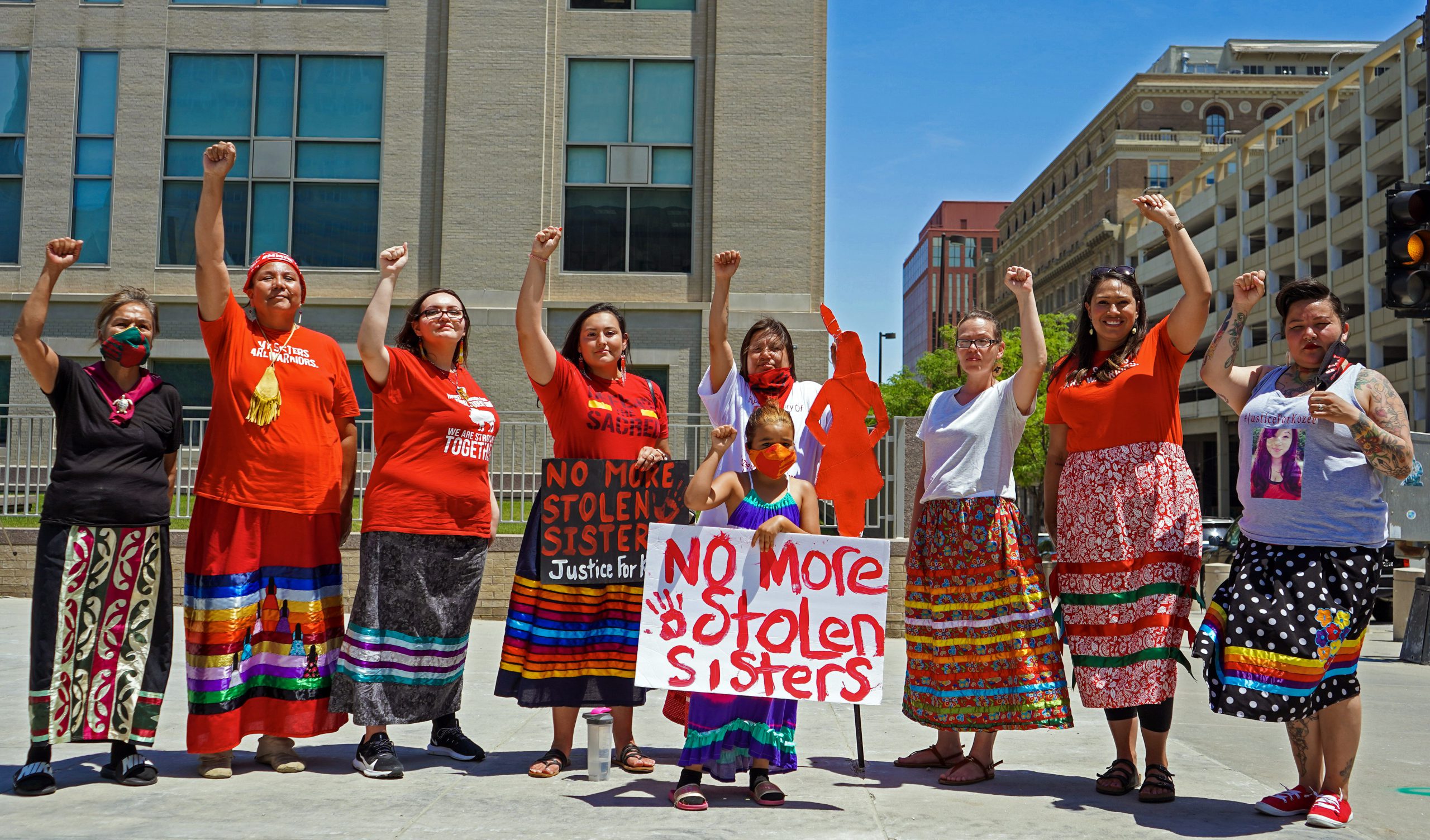 Native women are seen in Omaha, Nebraska, on June 15, 2020, at a rally in support of Kozee Decorah and her family. Decorah, a woman from the Ho-Chunk Nation, was murdered on the Winnebago Reservation in Nebraska. The perpetrator was sentenced to 25 years for manslaughter in the case. Photo by Kevin Abourezk
The week concludes with a panel on Thursday to hear from MMIW family members, the ones whose voices are to be represented on the Not Invisible Act Commission. The event takes place on May 5, which has been recognized as
National Day of Awareness for Missing and Murdered Native Women and Girls since 2017.
The day is named in memory of
Hanna Harris, a citizen of the
Northern Cheyenne Tribe who went missing in Montana, not long after her 21st birthday on May 5, 2013.
Two people were eventually sentenced for their roles in her
disappearance and murder, representing one of the rare instances in which the perpetrators in an MMIW case were brought to justice.
“Sadly, Hannah’s experience is one of countless stories of missing and murdered indigenous women were insufficient resources, lack of safe housing, jurisdictional confusion, and lack of police presence or response hampered efforts to immediately and appropriately respond to a family’s request for help regarding their missing loved one,” said Colfer, who is Tlingit, from the NIWRC.
Related Stories


