Indianz.Com >
News > ‘A bit of a conundrum’: Tribes facing new hurdles as self-determination law reaches major milestone
 Sen. Lisa Murkowski (R-Alaska), left, converses with Cherokee Nation Principal Chief Chuck Hoskin Jr. following a Senate Committee on Indian Affairs oversight hearing in Washington, D.C., on September 17, 2025. Photo by Indianz.Com (CC BY-NC-SA 4.0)
‘A bit of a conundrum’: Tribes facing new hurdles as self-determination law reaches major milestone
Tuesday, September 23, 2025
By Acee Agoyo
Indianz.Com
Fifty years into the self-determination era, tribal nations are running into new obstacles when it comes to managing programs that serve their people.
In 1975, the U.S. Congress enacted the
Indian Self-Determination and Education Assistance Act. The historic law ended decades of paternalism and termination at the federal level by recognizing the
authority of tribes to take over programs managed by government agencies.
“It’s no coincidence that 50 years later, the
Cherokee Nation has never been stronger, and our future is bright,”
Principal Chief Chuck Hoskin Jr., the leader of one of the two largest tribes in the United States, told the
Senate Committee on Indian Affairs last Wednesday.
“We can spend a dollar better, wiser and more efficiently than the federal government can,” Hoskin said at an
oversight hearing in Washington, D.C.

YouTube
Senate Committee on Indian Affairs Video: Oversight Hearing titled “Indian Self-Determination and Education Assistance Act Successes and Opportunities at the Department of the Interior and the Indian Health Service”
But the year 2025 has not exactly been a great milestone for the policy of self-determination. Emerging challenges imposed by the administration of President Donald Trump are making it harder for tribes to serve their communities, the Senate committee was told.
Tribes that have already entered into self-determination contracts with the
Bureau of Indian Affairs (BIA), for example, are being required to submit an additional justification each and every time they drawn down payments from pre-existing funding agreements. The obstacle is new — it came about after
Trump issued an executive order regarding federal payments about a month after becoming the 47th president of the United States.
Another mandate is related to
Trump’s opposition to diversity, equity and inclusion (DEI) programs, an effort that the president began on his first day in office. Tribes — despite being independent sovereign entities — are being told how to use certain funds already promised to them under their government-to-government relationship with the U.S.
“Adding new administrative burdens and micromanaging how tribes spend federal funds are contrary to the key tenants of self-governance,” Jay Spaan, the executive director of the
Self-Governance Communication and Education Tribal Consortium, said at the September 17 hearing.
Indianz.Com Audio: Indian Self-Determination and Education Assistance Act Successes and Opportunities at the Department of the Interior and the Indian Health Service
A third obstacle has arisen with respect to a popular self-determination program in which
tribes lease facilities to the BIA as a way to boost economic development on their lands. Guidelines issued this summer are making it all but impossible to enter into a 105(l) agreement due to the rural nature of most Native communities, the committee was told.
The new 105(l) guidelines require tribes to provide an analysis of three comparable facilities to the BIA — a tall order in areas of Indian Country where multiple, suitable buildings often do not exist. Previously, only one such “comp” was needed for a lease agreement.
“The cost to just get one comp is really significant and it took us months to get through that,” said Victor Joseph, the executive director of the
Tanana Tribal Council in Alaska.
“And so if you’re having to look at, in Alaska, how to bring three to the table so that you can work through your 105 agreement, that’s gonna be at a very high cost,” added Joseph, who said his tribe has been told that it will take up to 13 months just to enter into a lease with the BIA.
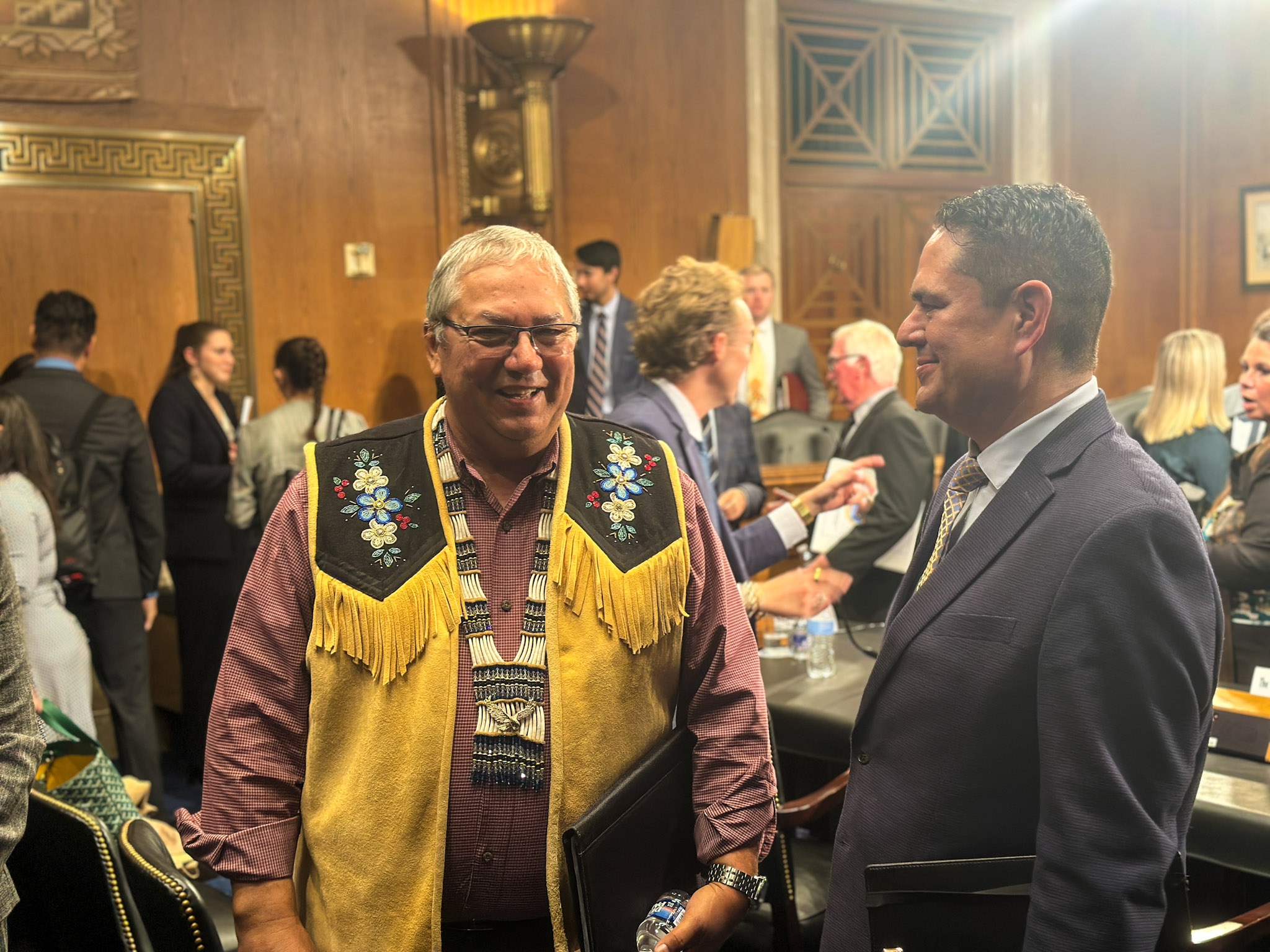 Victor Joseph of the Tanana Tribal Council, left, converses with and Ben Smith of the Indian Health Service following a Senate Committee on Indian Affairs oversight hearing in Washington, D.C., on September 17, 2025. Photo by Indianz.Com (CC BY-NC-SA 4.0)
Sen. Lisa Murkowski
Victor Joseph of the Tanana Tribal Council, left, converses with and Ben Smith of the Indian Health Service following a Senate Committee on Indian Affairs oversight hearing in Washington, D.C., on September 17, 2025. Photo by Indianz.Com (CC BY-NC-SA 4.0)
Sen. Lisa Murkowski (R-Alaska), the Republican chair of the Senate Committee on Indian Affairs, has already heard complaints about the new 105(l) guidelines, which she said were developed without tribal consultation. She argued that the changes are having a negative effect on the exercise of self-determination.
“What we’re trying to do here is meet the requirements of the law, meet the requirements of the trust responsibility,” Murkowski observed. “When you you put in place guidance that is really not only, not practical, but simply not workable, in a place like Alaska — again requiring the use of three comparable sites and appraisals, where you simply don’t have comparable facilities.”
“I’m assuming this comes about because somebody just wasn’t thinking, they weren’t thinking about the challenges that we face in so many parts of the country, but most particularly up in Alaska,” Murkowski continued.
Kennis Bellmard, a citizen of the
Kaw Nation who serves as the Deputy Assistant Secretary for Policy and Economic Development for Indian Affairs, agreed that the new 105(l) guidance is unworkable. He cited his own experience as a tribal attorney in Oklahoma, which boasts the highest percentage of American Indians and Alaska Natives of any state.
“Before I came here, I was a tribal attorney for 35 years. I lived in, and my office was in, a town of about 300 people,” Bellmard told the committee. “We took advantage of the 105(l) program, which is a very popular program.”
“To get three comps in Kaw City, Oklahoma, I would agree like Alaska, that that’s impossible,” Bellmard said.
 Kennis Bellmard, the Deputy Assistant Secretary for Policy and Economic Development for Indian Affairs at the Department of the Interior, is seen among the crowd following a Senate Committee on Indian Affairs oversight hearing in Washington, D.C., on September 17, 2025. Photo by Indianz.Com (CC BY-NC-SA 4.0)
But Bellmard, who is holding a
political appointee job within the Donald Trump administration, was unable to explain how the 105(l) guidance came about — other than to assert that he had nothing to do with it. He said the new information did not come from his “hallway” at the main
Department of the Interior building in Washington, D.C.,
“When we had started hearing in our hallway that there had been some decision related to this guidebook, we immediately talked to our self-governance people, asked them to reach out to find out where that actual information in the guidebook had come from and to confirm that that is actually what we’re doing,” Bellmard said.
Bellmard then told the committee that he has instructed the BIA not to follow its own guidebook, pending further reviews of the 105(l) process within the
Office of Tribal Leases.
“And if it is what we’re doing, we have asked our folks not to do that until they can spend some time with us so we can determine why the decision in this guidebook was made for these three comps, because it is not practical for rural Indian Country,” Bellmard said.
“I’m glad to hear you say it,” Murkowski responded.
“I would just ask that you move expeditiously on this because if this is in place and you do have folks that are looking at things and saying, ‘Well, we don’t have the three comps, so we can’t do it,’ again, what you are doing is just adding to further delay in execution of these 105(l) leases,” Murkowski continued.
“And that’s absolutely the opposite of what we’re trying to do here,” said Murkowski.
When it comes to the justifications needed to draw down self-determination funds, Bellmard was less certain about a fix. He attributed the requirement to the fact that the BIA pays tribes through the
Automated Standard Application for Payments (ASAP), an electronic system that is housed at the
Department of the Treasury.
According to Bellmard, the Department of the Interior has proposed a solution that he said the Department of the Treasury has yet to accept.
“As soon as we got that information, we began negotiating with Treasury and we have an agreement in principle with Treasury that of course, being the government, we have to work through that,” Bellmard said when asked by Murkowski why justifications were being required at the BIA, especially since they are not required when the
Indian Health Service at the
Department of Health and Human Services makes self-determination payments to tribes.
“So it will be similar to what we see at IHS?” Murkowski asked Bellmard.
“Yes,” Bellmard replied.
 Name placards for Ben Smith, left, and Kennis Bellmard are seen on a table in Room 628 of the Senate Dirksen Office Building following a Senate Committee on Indian Affairs oversight hearing in Washington, D.C., on September 17, 2025. Photo by Indianz.Com (CC BY-NC-SA 4.0)
After being asked about the payments by
Sen. Catherine Cortez Masto (D-Nevada), Bellmard said the solution simply calls on Interior to send a list of federally recognized tribal recipients to Treasury.
“Once the recipient list goes to Treasury of all the self-governance funds, then there won’t be a requirement for justifications,” Bellmard said.
“Is that in writing?” Cortez Masto inquired.
“We are undergoing that,” Bellmard said. “We’re working on the procedure that will allow for that to happen.”
Upon even further questioning from
Sen. Brian Schatz (D-Hawaii), the Democratic vice chair of the Senate Committee on Indian Affairs, Bellmard was unable to explain why Treasury hasn’t accepted Interior’s solution — and he declined to speculate whether the fix would take days, weeks or even months, to implement.
“Because if Treasury still gets to say whether you’re, you know, green, yellow, or red, then we’re back to violating the law,” Schatz said in reference to the Indian Self-Determination and Education Assistance Act. “But maybe even more to the point, just slowing things down to the point where they don’t function. Right?”
Bellmard conceded that the justifications appear to be interfering with the exercise of self-determination in Indian Country.
“The purpose of self-governance is to make this easier for tribes, to have their own control over these things,” Bellmard. “So, yes, it is a bit of a conundrum.”
 Sen. Lisa Murkowski (R-Alaska), left, poses with Executive Director Victor Joseph of the Tanana Tribal Council following a Senate Committee on Indian Affairs oversight hearing in Washington, D.C., on September 17, 2025. Photo by Indianz.Com (CC BY-NC-SA 4.0)
Murkowski noted that she envisioned the oversight hearing as a way to share the “successes” of the self-determination era over the last 50 years. She told Bellmard that hurdles could instead lead to a weakening of the policy.
“When people get discouraged because they think things are just too hard or the costs have been too much, so it just doesn’t make sense anymore, they kind of give up,” Murkowski said as the hearing came to a close.
“And that’s exactly, the wrong way to go when we’re talking about self-determination,” Murkowski said.
“So we wanna build on the successes, we wanna get the obstacles out of the way because we all need to be pulling together to see the benefits,” Murkowski continued.
Although Bellmard holds a political position at the Department of the Interior, he was not subject to confirmation by the
U.S. Senate. He has been on the job since at least February, according to correspondence sent by tribal advocates earlier in the year.
The BIA highlighted Bellmard’s presence in a
news release dated April 14. At one point, he was holding the title of “Acting Principal Deputy Assistant Secretary of Indian Affairs,” according to a
May 23 policy alert from NAFOA, the inter-tribal finance organization.

Indianz.Com
The Trump administration otherwise lacks an official Assistant Secretary for Indian Affairs to lead the BIA.
William “Billy” Kirkland, a citizen of the
Navajo Nation who resides in Georgia, has yet to be confirmed for the job following
consideration of his high-profile nomination by Murkowski’s committee.
“I think we’ve got to give him a chance to do this job,” Murkowski said at a
business meeting on September 10 after acknowledging that Kirkland was an “unconventional choice for this position as he is not a legal scholar, steeped in federal Indian law or a tribal leader.”
“We need Mr. Kirkland swiftly confirmed so that this important hallway at Interior can get going on all the important work that is piling up, waiting for an Assistant Secretary,” Murkowski said as Kirkland was advanced by a committee vote of 7 to 4, largely along party lines.
Schatz was the only Democrat who voted in support of Kirkland, who lacks the same type of experience in Indian law and policy that his predecessors have brought to the job.
“He promised to treat all tribes equally — no matter if they have a treaty with the United States, how they voted for president, or how or when they were federally recognized in accordance with the law,” Schatz said of Kirkland
at the meeting.
The Republican-controlled Senate has yet to take further action on Kirkland, who was nominated by President Trump on February 3. But on the day after the self-determination hearing,
Sen. John Thune (R-South Dakota), the
majority leader in the chamber, introduced
S.Res.412 to approve Kirkland’s nomination in an expedited manner.
Due to rule changes adopted by the Republican majority, Kirkland and 107 other political nominees can be confirmed all at once by a majority vote. Previously, each nomination had to be considered on its own through a process that could take months to complete.
According to a
September 3 order signed by
Secretary of the Interior Doug Burgum,
Janel Broderick is carrying out the duties of the Assistant Secretary for Indian Affairs. Broderick, who is non-Indian, is officially serving as the Principal Deputy Assistant
Secretary for Indian Affairs at Interior.
“Proudly serving the Office of Indian Affairs,” Broderick states on one of her
social media profiles.
Prior to Broderick, Scott Davis, a citizen of the
Standing Rock Sioux Tribe from North Dakota, had been carrying out the duties of the Assistant Secretary for Indian Affairs. BIA employees have since been told he has returned to his
official title of “Senior Advisor” to Secretary Burgum, who also hails from North Dakota.
Burgum, a former two-term governor of North Dakota, has not publicly commented on Kirkland or Kirkland’s nomination.
Senate Committee on Indian Affairs Notice
Oversight Hearing entitled “Indian Self-Determination and Education Assistance Act Successes and Opportunities at the Department of the Interior and the Indian Health Service” (September 17, 2025)
Related Stories

