Indianz.Com > News > Albert Bender: Decolonization during the holiday season

 youtu.be
 Decolonizing the holiday: A way forward on Thanksgiving?
Tuesday, January 4, 2022
People's World
Though Thanksgiving is now passed, People’s World thinks it important to bring the following commentary article to our readers from Albert Bender, a regular PW correspondent. After speaking at a Native event this year on the “holiday,” he penned the following reflections.
The Thanksgiving holiday, or as it is also called by many “Thanks-taking” or “Thanks-stealing,” has become more complicated as time rolls on. It has certainly become so for many Indigenous people. Many are calling it a day of mourning, and having recently spoken at a university Native student venue against the so-called “holiday,” I subsequently reflected on the significant diversity of opinions about what to do or not do on this mythical day, which seems to depend to a certain extent on geography and history.
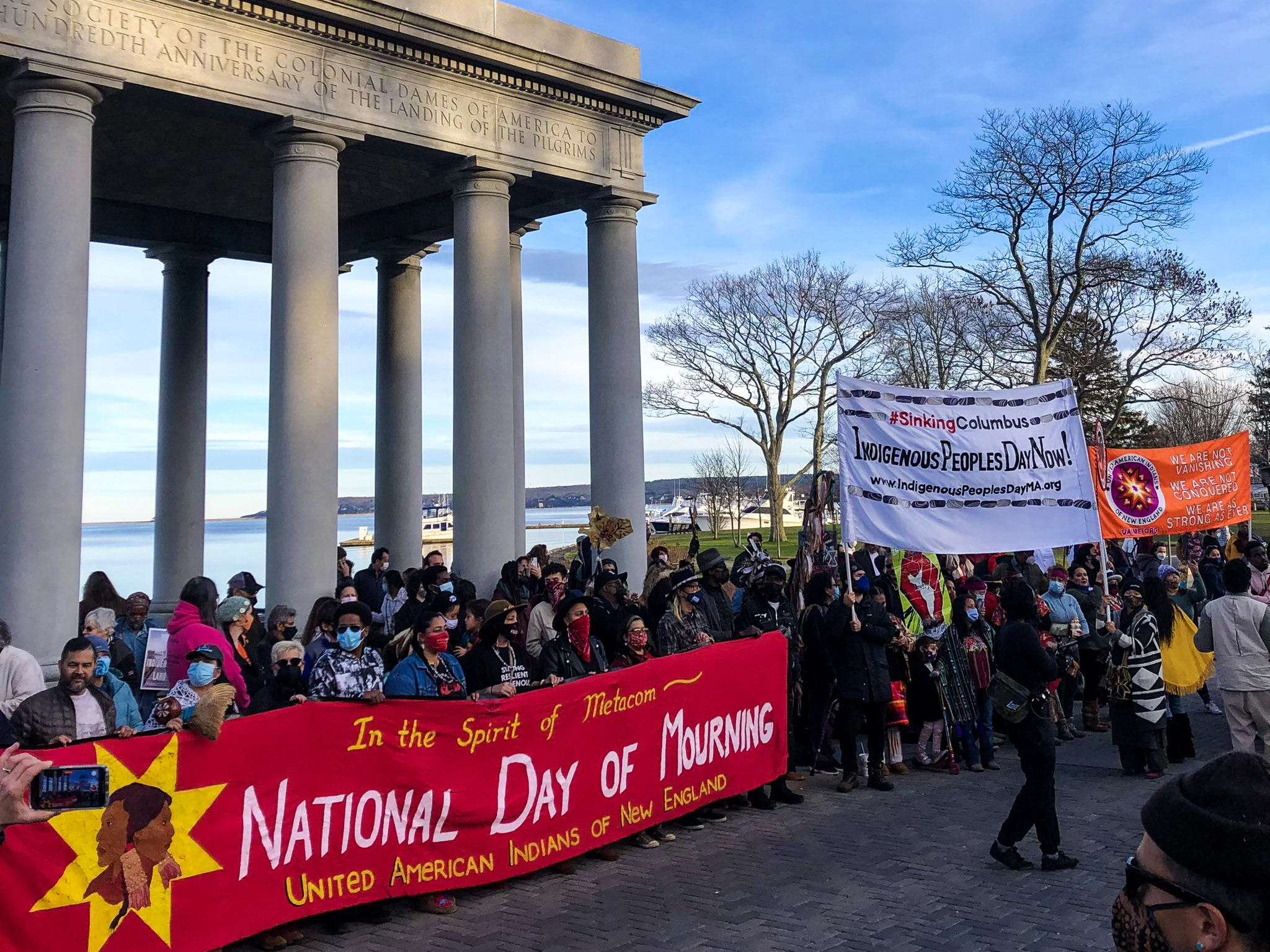
But first let’s give due reverence to the United American Indians of New England (UAINE) who since 1970 have held a “National Day of Mourning” (NDOM) at Cole’s Hill in Plymouth, Massachusetts. The UAINE dispels the narrative of Indians and Pilgrims planning a feast on this day and instead corrects history by relating that Wampanoag warriors by happenstance ended up on a fall day, in 1621, at a Pilgrim dinner and of course accepted an invitation to a meal since they were already at the settlement.
The 2021 NDOM was live-streamed from Plymouth with messages from Indigenous struggles in other homelands.

— Kisha James (@Kisha890) November 24, 2021UAINE co-leader Mahtowin Munro recognized and gave a rousing welcome to those who traveled far, including buses from the Haitian community of Brooklyn and also Borinquen and Taino people who came from Yankee Stadium. There was also a large Palestinian contingent in attendance. The NDOM addressed the thousands of mass graves of Indigenous children that have been found at former locations of Canadian residential schools. Speakers advocated for the search to continue at U.S. boarding school sites. The cry of “Free Leonard Peltier” resonated with a recent statement from the long imprisoned political prisoner that read, “I remain grateful for the gift of life.” There was increased hope for his release based on a clemency letter addressed to President Biden and written by former U.S. Attorney James Reynolds, who put Peltier behind bars and who now feels that the sentencing “was and is unjust.” Biden was criticized and lambasted for hypocrisy in attending COP26 and only days later selling 88 million acres of Gulf Coast waters for offshore oil drilling. With the sun setting, the gathering marched to Post Office Square, where there is a plaque commemorating Metacom, the Indigenous leader who led Native people in a year-long war against the European colonists. Metacom was murdered, and his head was put on a pike at the Square location for over 2020 years as a warning to surviving Indigenous people. His wife and son, captured in the war, were sold into overseas slavery. Focus was also given to the MMIWG. This ongoing tragedy was described as “genocide.” The NDOM ended with calls for action.
Native American unity—and diversity—on dealing with Thanksgiving
Indigenous people in the U.S. solidly back the narrative that the Pilgrims were the aggressors in committing genocide against those Native people who extended the olive branch of peace and friendship. The crimes of the Pilgrims are ongoing. Hence, it can be well understood that the National Day of Mourning in the Northeast also is ongoing and is supported by Tribal nations across the country. In that there is unity.
When it comes to activities on Thanksgiving, there is a great deal of difference in activity. For many Native Americans, it is a day to gather with family and friends and share Indigenous food. Myself in times past went from fasting on Thanksgiving to being with friends and their family members on the Laguna Pueblo reservation in New Mexico.
Other Indigenous observers respond to the “holiday” with: “We are not celebrating Thanksgiving; we are just thankful for what we have left.” For them, it is a celebration of Indigenous survival. Among no one is there a celebration of the myth of friendship between Indians and Pilgrims (keep in mind that the English and Wampanoags fought a war in 1675-76 in which thousands perished on each side).
For those that simply gather for fellowship and food, this is not to say that they are any less devoted to the “cause” or any less conscious of the plight of Native people than those who gather at Plymouth for the NDOM.

Decolonizing Thanksgiving
Many Indigenous people see the way forward in the direction of “decolonizing” Thanksgiving. The value in this movement is that Thanksgiving can be used as an educational tool to raise the consciousness of those in mainstream society who are starting to view the “holiday” differently and recognize the need for the correction of history and to correct the many racist wrongs perpetrated in this society against the Indigenous to this very day.
As the “Decolonize Thanksgiving” movement goes forward, various ways are being proposed to accomplish the task, with some already in place. Education is at the forefront of this phalanx of activity. There should be learning about the true history of the Wampanoag people who first met the Pilgrims; learning how the Indigenous people were largely decimated by European fishermen bringing disease long before the so-called first Thanksgiving, and that Wampanoags captured by these early visitors were sold into slavery in Europe and North Africa.
People should learn that the Pilgrims were not seeking religious freedom, which they already had in the Netherlands, but were part of a nascent capitalist profit-driven venture.
There are some suggestions to rename this controversial day, such as Happy Maize Day or Indigenous Foods Day. Other suggestions include non-Natives finding out whose land they are living on, learning about the treaties and why they matter, reading the works of Indigenous authors, ending the use of Native mascots in sports, supporting the land back efforts of Indigenous nations, attending where possible Native public gatherings such as pow-wows, reforming school curriculums to tell the true history of U.S. Indigenous Nations and having community libraries organize educational programs on Native history and current Indigenous issues.
All of the above can go a long way toward the decolonization of this so-called “holiday.”
As with all op-eds published by People’s World, this article reflects the opinions of its author.
Albert Bender is a Cherokee activist, historian, political columnist, and freelance reporter for Native and Non-Native publications. He is currently writing a legal treatise on Native American sovereignty and working on a book on the war crimes committed by the U.S. against the Maya people in the Guatemalan civil war of the late 20th century. Albert is a consulting attorney on Indigenous sovereignty, land restoration, and Indian Child Welfare Act (ICWA) issues. He is the recipient of several Eagle Awards by the Tennessee Native American Eagle Organization.
This article originally appeared on People's World. It is published under a Creative Commons license.
Search
Filed Under
Tags
More Headlines
Native America Calling: How a young Ponca activist shaped the future of Native activism
Native America Calling: Tribes remain excluded from some major water policy decisions
Native America Calling: Assessing college campus safety in light of troubling allegations at Cornell University
Native America Calling: Native authors and book sellers reflect on a record year for banned books
Native America Calling: Native Playlist with Jeremy Dutcher and Mali Obomsawin
Native America Calling: What removing questions about race from the U.S. Census means for Native Americans
Chuck Hoskin: Cherokee Nation employees serve their communities
Native America Calling: One tribe breaks from the pack on prediction markets
Native America Calling: Finding success through the art of contemporary horsemanship
Testimony: Stephanie Bryan, Poarch Band of Creek Indians
Testimony: Michell Hicks, Eastern Band of Cherokee Indians
Testimony: Mark Macarro, Pechanga Band of Indians
Testimony: Patricia Leach, Catawba Nation
Testimony: Bryan Mercier, Bureau of Indian Affairs
Senate Committee on Indian Affairs holds business meeting and legislative hearing
More Headlines
Native America Calling: Tribes remain excluded from some major water policy decisions
Native America Calling: Assessing college campus safety in light of troubling allegations at Cornell University
Native America Calling: Native authors and book sellers reflect on a record year for banned books
Native America Calling: Native Playlist with Jeremy Dutcher and Mali Obomsawin
Native America Calling: What removing questions about race from the U.S. Census means for Native Americans
Chuck Hoskin: Cherokee Nation employees serve their communities
Native America Calling: One tribe breaks from the pack on prediction markets
Native America Calling: Finding success through the art of contemporary horsemanship
Testimony: Stephanie Bryan, Poarch Band of Creek Indians
Testimony: Michell Hicks, Eastern Band of Cherokee Indians
Testimony: Mark Macarro, Pechanga Band of Indians
Testimony: Patricia Leach, Catawba Nation
Testimony: Bryan Mercier, Bureau of Indian Affairs
Senate Committee on Indian Affairs holds business meeting and legislative hearing
More Headlines