Indianz.Com > News > Fawn Sharp: Tribal consent becomes the law in Washington state
Washington State Tribal Coalition Passes Unprecedented Climate Change Bill, Puts Consent Instead of Consultation Into Law
Groundbreaking state law will provide billions for Tribes, while Tribes overcome a Governor Jay Inslee veto to put “consent” into law
Friday, May 21, 2021
It was never a matter of if, but when.
That’s what we said, year after year, defeat after defeat, as Tribal Nations in Washington State tried again and again and again to pass the comprehensive, aggressive climate change legislation.
No matter how each legislative or electoral battle went, we all knew this was not a war we could lose. Surrender would never be an option. Science told us clearly the policies that were absolutely necessary to enact to ensure the survival of our state’s ecosystems and the communities they sustain.
For years we worked on behalf of the Quinault Nation, as the ancestral coastal rainforest villages of Taholah and Queets on the Pacific Coast faced increasing flooding from sea level rise – and Quinault was only one of a half-dozen Tribes facing urgent crises from sea level rise across the state.
We had to keep trying until we developed the strategy that succeeded in confronting the existential crisis of our generation, and generations to come, and provided the enormous resources needed for those Tribal Nations to safely and urgently relocate their villages further upland.
It’s not a matter of if, but when.
That’s also what we said when every elected official in the state said that Tribes would never get guaranteed funding parity worth billions of dollars into law. While the entire country suffers a “Quiet Crisis” of systematic underfunding of Tribes at every level, we were dreamers to ever imagine that we could hardwire funding equity into law in Washington State, finally guaranteeing a level playing field after generations of systematic resource deprivation.
It’s not a matter of if, but when.


Governor Jay Inslee’s Betrayal
Despite supporting the consent provisions in the Climate Commitment Act [SB5126] when he needed Tribal support to pass the bill in the Legislature, despite supporting it both in his presidential campaign and in the I-1631 initiative campaign in 2018, Jay Inslee betrayed Tribes on May 16, 2021, by breaking his word and vetoing all of the Tribal consultation and consent language out of the CCA. This was the same language his office, and his party, negotiated and never objected to only weeks before.
That’s exactly why the only thing Fawn Sharp and Donald Trump will ever agree on is that Jay Inslee is a snake.
With this cowardly ambush, Inslee thought he had defeated Tribes and shown them who was boss. Consent was not going into Washington law his veto trumpeted, because it would re-define the relationship between Tribes and the State. . . which was exactly the point when it came to desecrating sacred sites and burial grounds.
Unfortunately, Governor Inslee had actually lost the battle an entire month earlier on April 16, 2021.
We just hadn’t bothered to tell him.

History Being Made
To get back to the CCA, it’s impossible to exaggerate the importance of the pathway Washington Tribes have now cleared.
It is a trail to the Promised Land that many other states and Tribal Nations, and eventually Congress, will have no choice but to follow as the impacts of climate change become ever more dire, and the desperate need for Tribal expertise and resources in co-managing the response is better appreciated.
When the “Climate Commitment Act” was passed by the Washington State Legislature in April of 2021, the historic victory was the product of tens of thousands of hours of grassroots organizing, advocacy, strategic planning, policy development, and political gamesmanship by Washington’s Tribes and incalculable millions of dollars of investments.
The proof is in the legislation: you can definitively tell by the precedent-shattering policies contained within the “cap and invest program” created by the Climate Commitment Act that it was the rare American legislation sincerely co-written by sovereign Tribes.
In short, there is a reason this legislation attracted the formal support of nineteen sovereign Tribal Nations, as well as the Affiliated Tribes of Northwest Indians (ATNI): it contained policies that Tribes clearly were invested in supporting and enacting.
The outcome – a career-defining victory for Governor Jay Inslee and Washington Democrats, and a place in history for legislative hero Rep. Joe Fitzgibbon – demonstrates that political benefit of American states partnering with Tribal Nations is almost as great as the policy results.
Besides the vetoed consent provisions that are temporarily absent from the law, the CCA contains two precedent setting policies first introduced in the Tribally co-authored I-1631 initiative: a mandate in law that 10% of all carbon revenue go to Washington Tribes because of the 10% of state lands directly governed by Tribes, and mandated public funding for the relocation projects for Tribes whose ancestral villages are being flooded and rendered uninhabitable by sea level rise.
As co-authors of both the policies that originated I-1631 initiative and the strategy that created them in negotiations, our goal from the beginning was explicit: win or lose at the ballots in 2018, the previously “radical” and “far-fetched” Tribal policies negotiated into I-1631 would have to be supported by almost every institutional environmental nonprofit and Democratic Party politician in Washington State once it was on the ballot.
The “radical” Tribal policy requests would thus be mainstreamed in all future climate policy debates – and would be supported by our community of color allies who would stand in solidarity with Indigenous peoples like we have and always will with them.


The Hand of the Creator
Once the I-1631 provisions were included by Representative Joe Fitzgibbon, the result was miraculous. The most important bill in Washington State history’s most controversial and technically complex sections were somehow negotiated, drafted, and passed in only two weeks in partnership with nineteen Tribal Nations, all of them diverse and unique in their outlook and needs, who reached consensus with each other and a majority of legislators in both chambers.
Somehow, we kept the entire coalition together until the very end.
It’s hard not to see the hand of the Creator in such an unlikely underdog come-from-behind victory.
Thanks to the brilliance, power, and moral leadership of Washington’s Tribal Nations, the far-fetched dreams of I-1631 is now state law – as well as a call to action to Tribes nationwide to seize the moment, fill the leadership vacuum, and help lead this country to urgently and aggressively fight the challenge of climate change.
We know it’s not a matter of if, but when, Tribes nationwide will accomplish the impossible … again.
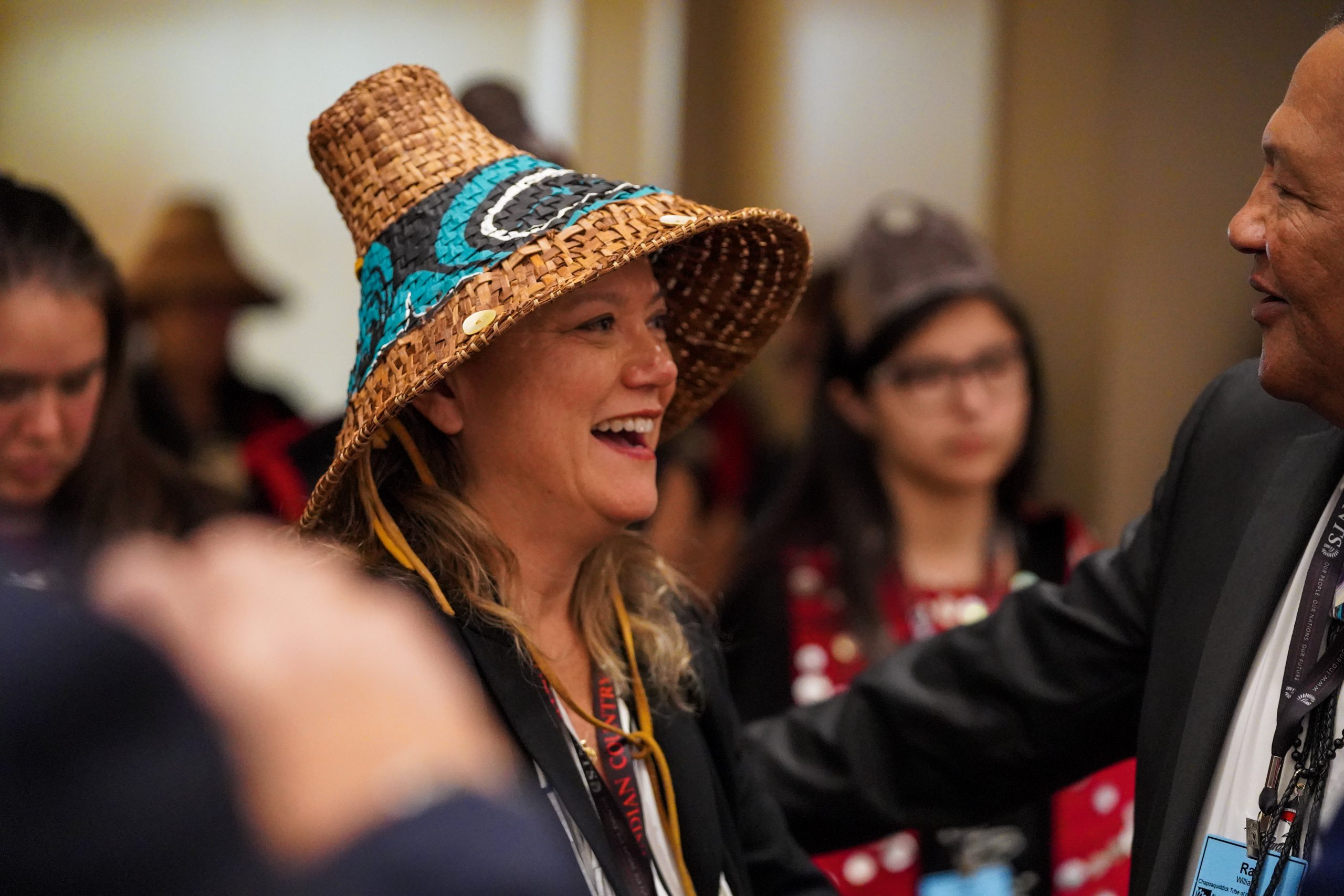
Fawn Sharp is a human rights attorney who serves as the President of the National Congress of American Indians and the Vice President of the Quinault Nation. She served as the five-term President of the Quinault Nation from 2006-2021. Matthew Randazzo V is a published author and former senior state environmental executive who is President Sharp’s senior adviser and represents and advises Tribal Nations.
Search
Filed Under
Tags
More Headlines
Native America Calling: Finding success through the art of contemporary horsemanship
Testimony: Stephanie Bryan, Poarch Band of Creek Indians
Testimony: Michell Hicks, Eastern Band of Cherokee Indians
Testimony: Mark Macarro, Pechanga Band of Indians
Testimony: Patricia Leach, Catawba Nation
Testimony: Bryan Mercier, Bureau of Indian Affairs
Senate Committee on Indian Affairs holds business meeting and legislative hearing
Native America Calling: How Indigenous voices adapt to rapidly-evolving media
Native America Calling: PBS documentary ‘Knowledge Keepers’ explores Native scientific innovations
Testimony: Alicia Puente Cackley, Government Accountability Office
Testimony: Hilary Atkin, Department of Housing and Urban Development
Testimony: Bryan Warner, Cherokee Nation
VIDEO: H.R.741 – Stronger Engagement for Indian Health Needs Act of 2025
VIDEO: H.R.6021 – Archie Cavanaugh Migratory Bird Treaty Clarification Act
Senate Committee on Indian Affairs takes up Native housing
More Headlines
Testimony: Stephanie Bryan, Poarch Band of Creek Indians
Testimony: Michell Hicks, Eastern Band of Cherokee Indians
Testimony: Mark Macarro, Pechanga Band of Indians
Testimony: Patricia Leach, Catawba Nation
Testimony: Bryan Mercier, Bureau of Indian Affairs
Senate Committee on Indian Affairs holds business meeting and legislative hearing
Native America Calling: How Indigenous voices adapt to rapidly-evolving media
Native America Calling: PBS documentary ‘Knowledge Keepers’ explores Native scientific innovations
Testimony: Alicia Puente Cackley, Government Accountability Office
Testimony: Hilary Atkin, Department of Housing and Urban Development
Testimony: Bryan Warner, Cherokee Nation
VIDEO: H.R.741 – Stronger Engagement for Indian Health Needs Act of 2025
VIDEO: H.R.6021 – Archie Cavanaugh Migratory Bird Treaty Clarification Act
Senate Committee on Indian Affairs takes up Native housing
More Headlines