Indianz.Com > News > Bureau of Indian Affairs provides more funding for Columbia River treaty fishing sites
Bureau of Indian Affairs provides more funding for Columbia River treaty fishing sites
Monday, October 7, 2024
Indianz.Com
The Bureau of Indian Affairs is investing nearly $10 million in tribal treaty fishing sites along the Columbia River.
Assistant Secretary for Indian Affairs Bryan Newland traveled to the Columbia River last week to announce the funding. He said the money will ensure the Nez Perce Tribe, the Confederated Tribes of the Umatilla Indian Reservation, the Confederated Tribes of the Warm Springs Reservation and the Yakama Nation can continue to exercise their treaty rights.
“These fishing sites are critical to supporting traditional fishing and ways of life here along the Columbia River,” Newland said in an October 1 news release. “This investment is part of our ongoing work to ensure that Native people have the right to continue to exist, as Native people, in their Tribal communities.”
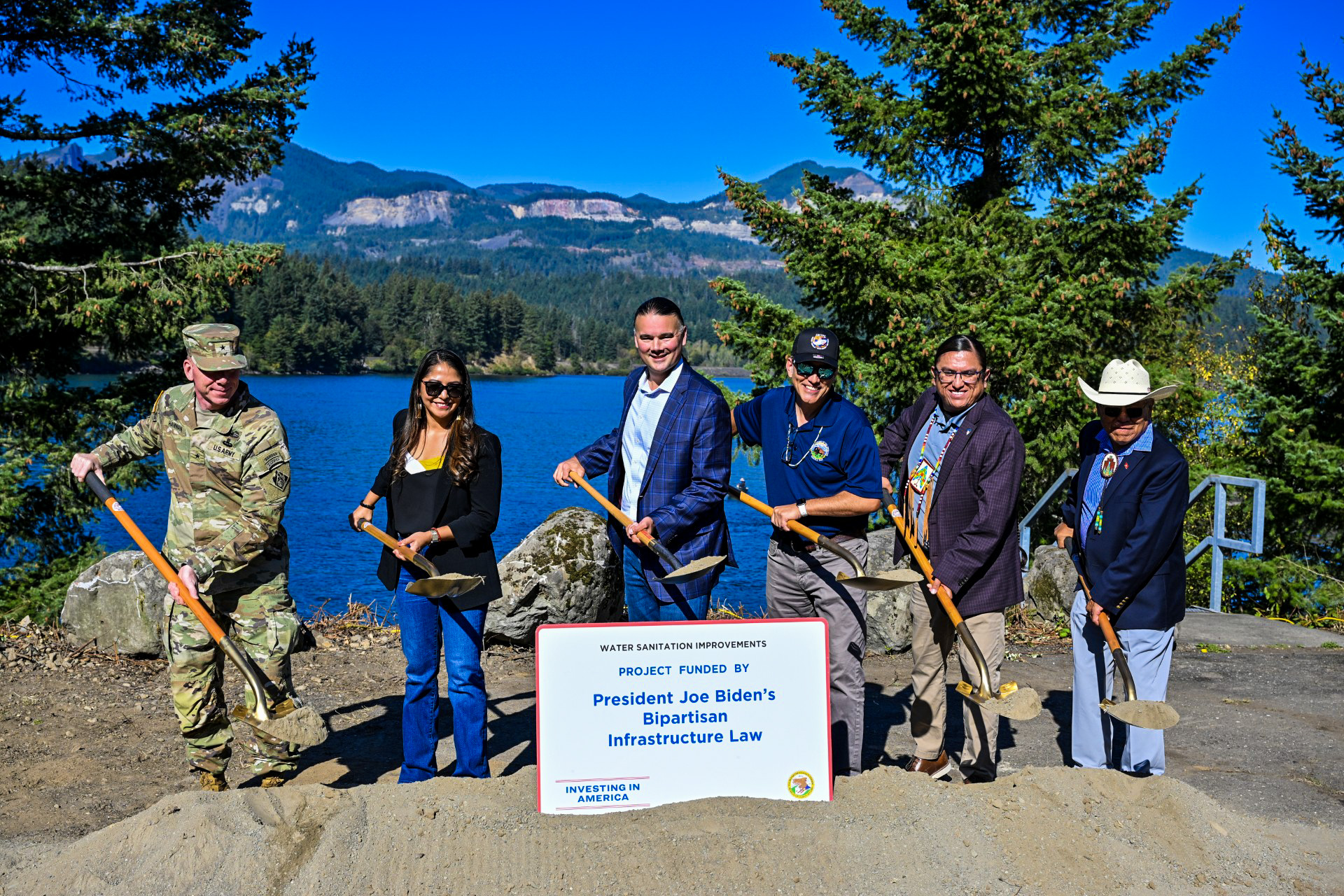
Honoring the past, shaping the future: yesterday marked the groundbreaking for improvements at the Cascade Locks Tribal…
Posted by Columbia River Inter-Tribal Fish Commission on Wednesday, October 2, 2024
Posted by Columbia River Inter-Tribal Fish Commission on Tuesday, October 1, 2024
Indian Affairs invests nearly $10 million to rehabilitate Columbia River Treaty Fishing Access Sites, as part of President’s Investing in America agenda
Bipartisan Infrastructure Law will support improved clean water and sanitation facilities for Tribal fishers
The following is the text of an October 1, 2024, news release from the Bureau of Indian Affairs.
CASCADE LOCKS, Oregon — The Office of the Assistant Secretary for Indian Affairs today announced a nearly $10 million investment from President Biden’s Investing in America agenda to provide critical rehabilitation at Tribal fishing sites along the Columbia River.
In-Lieu and Treaty Fishing Access Sites were set aside by Congress for Tribal members of the Nez Perce, Umatilla, Warm Springs, and Yakama Tribes to exercise their rights to fish in the Columbia River. Many of these sites are currently in poor shape, needing improvements to ensure the health and safety of Tribal fishers and their families.
The funding, which comes from the Bipartisan Infrastructure Law, was announced by Assistant Secretary for Indian Affairs Bryan Newland during a groundbreaking event for new water and sewer system upgrades at the Cascade Locks Treaty In-Lieu site in Oregon, one of the locations to benefit from this announcement. Today’s investment will help build restrooms and showers, fish cleaning and waste management stations, dish washing facilities, fire hydrants, as well as make lighting and safety upgrades.
“These fishing sites are critical to supporting traditional fishing and ways of life here along the Columbia River,” Assistant Secretary Newland said. “This investment is part of our ongoing work to ensure that Native people have the right to continue to exist, as Native people, in their Tribal communities.”
The Bureau of Indian Affairs funded a comprehensive condition and needs assessment for all 31 Columbia River in-lieu and treaty fishing access sites, which identified $16 million in needed improvements. In the past three years, Indian Affairs has provided $6.6 million to begin engineering and design for projects at sites with the greatest infrastructure needs, including rehabilitation of water and wastewater systems. Today’s announcement, which includes $9 million from the Bipartisan Infrastructure Law and $928,080 from annual appropriations will further provide funding to assist in addressing project needs identified by the needs assessment.
Projects from today’s announcement will be funded at the Lone Pine, Cascade Locks, Lyle Maryhill, Celilo, Dallesport, Stanley Rock, White Salmon, Roosevelt, Wyeth, Le Page, Pasture Point, Underwood, Preachers Eddy, Faler Road, and Crow Butte in-lieu or treaty fishing access sites.
These investments build on a broad effort by the Biden-Harris administration to support Tribally led efforts to restore healthy and abundant populations of salmon and other native fish in the Columbia River Basin. In September 2023, President Biden issued a presidential memorandum to advance these efforts, and the Administration announced an agreement to restore salmon populations in the Upper Basin. In December 2023, the Administration also announced an historic agreement to restore salmon populations in the Lower Basin, expand Tribally sponsored clean energy production, and provide stability for communities that depend on the Columbia River System for agriculture, energy, recreation and transportation.
Search
Filed Under
Tags
More Headlines
AUDIO: H.R.2916, a bill to ratify the Akwesasne Mohawk Land Claim
AUDIO: H.R.2389, the Quinault Indian Nation Land Transfer Act
AUDIO: H.R.2388, the Lower Elwha Klallam Tribe Project Lands Restoration Act
AUDIO: H.R.2302, the Shingle Springs Band of Miwok Indians Land Transfer Act
Native America Calling: Tribes fight for solutions to dwindling clean water sources
Native America Calling: Mental health experts point to personal connections to maintain winter mental health
Native America Calling: Tribes ponder blood quantum alternative
Defense bill snubs Indian Country in favor of Lumbee federal recognition
NAFOA: 5 Things You Need to Know this Week (December 8, 2025)
Chuck Hoskin: Cherokee Nation benefits from extension of health care credits
Native America Calling: Tribal museums reflect on tumultuous year, chart their next steps
Press Release: National Museum of the American Indian hosts Native art market
AUDIO: Sea Lion Predation in the Pacific Northwest
Native America Calling: Tribal colleges see an uncertain federal funding road ahead
Native America Calling: Short films taking on big stories
More Headlines
AUDIO: H.R.2389, the Quinault Indian Nation Land Transfer Act
AUDIO: H.R.2388, the Lower Elwha Klallam Tribe Project Lands Restoration Act
AUDIO: H.R.2302, the Shingle Springs Band of Miwok Indians Land Transfer Act
Native America Calling: Tribes fight for solutions to dwindling clean water sources
Native America Calling: Mental health experts point to personal connections to maintain winter mental health
Native America Calling: Tribes ponder blood quantum alternative
Defense bill snubs Indian Country in favor of Lumbee federal recognition
NAFOA: 5 Things You Need to Know this Week (December 8, 2025)
Chuck Hoskin: Cherokee Nation benefits from extension of health care credits
Native America Calling: Tribal museums reflect on tumultuous year, chart their next steps
Press Release: National Museum of the American Indian hosts Native art market
AUDIO: Sea Lion Predation in the Pacific Northwest
Native America Calling: Tribal colleges see an uncertain federal funding road ahead
Native America Calling: Short films taking on big stories
More Headlines